Für eine schnellere Antwort geben Sie bitte Ihre WhatsApp- oder Skype-Nummer in Ihre Nachricht ein, damit wir Sie so schnell wie möglich kontaktieren können.
Um uns eine schnellere Antwort zu ermöglichen, hinterlassen Sie bitte Ihre WhatsApp-Nummer, E-Mail oder Projektdetails. Wir antworten normalerweise innerhalb von 24 Stunden. Bei dringenden Anfragen kontaktieren Sie uns über WhatsApp: +8617862411260 oder WeChat: +8617862411260. Rufen Sie uns direkt an.
Lucy| Founder, Senserui | Published: 27 August 2026 · Last reviewed: 20 August 2026 Technical review: Senserui Engineering Team
Ein dust collector works in four stages: a hood captures dust at the source, ducted airflow conveys it, filter media separates it from the airstream, and the collected material discharges to storage. A fifth stage decides whether the first four keep working — periodic cleaning of the media, triggered by pressure.
Capture, convey, collect. That is the standard three-word description, and it appears in nearly every encyclopedia entry and supplier page on the subject. It is accurate and it is incomplete, because it describes a dust collector on the day it is commissioned.
A dust collector in month eighteen is a different machine. Media has loaded. Pressure drop has risen. The fan is working against more resistance and delivering less air than it did on day one. Whether that drift is measured in single-digit percentages or in a shop where the far machine no longer picks up depends almost entirely on the fifth stage that the three-word definition omits: how the media gets cleaned, and what triggers it.
What follows tracks one volume of air from a machine port to the silo, in order.
Dust that is never captured cannot be filtered. Capture is where most underperforming systems actually fail, and it fails silently because the collector itself looks fine.
Two things govern it. Airflow at the hood, and distance from the hood to the point where dust is generated. Suction from a plain opening falls off steeply with distance — for an unflanged opening, roughly with the square of it — so a hood positioned 200 mm from a cutting point and one positioned 400 mm away are not remotely equivalent, even though both are “connected to the system.”
This is why hood design outranks collector selection in its effect on breathing-zone concentration. A flanged hood, a partial enclosure, or a hood positioned to work with the process rather than against it recovers capture that no amount of extra fan power will buy. Fume from welding rises; grinding sparks and chips fly on a predictable trajectory; sanding dust is thrown tangentially off the belt. Each of those wants a differently shaped and differently positioned hood.
Once entrained, dust has to stay entrained for the whole duct run. The controlling number is transport velocity — the minimum air speed that keeps particles suspended in the airstream.
Fall below it and material settles in horizontal runs. In combustible-dust applications, that settled layer is fuel accumulating inside an enclosed volume with an ignition path leading to it. Go far above it and friction losses climb steeply, which shows up as fan power for the life of the system and as abrasion at elbows.
Branch airflow follows from duct area and that velocity, so the duct diameters and the required air volume are the same decision expressed two ways. The band is narrower than it looks when a network has twenty branches feeding one main, and holding velocity inside it across every segment is most of the design work.
Air enters the collector housing and slows down. Larger particles drop out on velocity alone. The rest reaches the filter media.
Here is the part that surprises people: on a surface-filtration collector, clean media is not the filter. The layer of collected dust on the media surface — the dust cake — does most of the fine filtration work. New elements typically run at their worst efficiency during the first hours of service, before a cake establishes.
Which explains a behaviour that otherwise looks like a fault. A collector that has just had its filters replaced can show a brief rise in emissions before settling down. Nothing is broken; the cake has not formed.
The cake is also what pressure drop measures. As it thickens, resistance across the media rises. That rising number is the single most informative reading on the machine, and it is the trigger for stage four.
Cleaning removes enough of the cake to restore airflow while leaving enough to keep filtering. That balance is the whole design problem, and it is handled two different ways.
Compressed-air pulse cleaning fires a short burst down the inside of the filter element, flexing the media and shedding the cake into the hopper below. It is the common method on centralized platforms, and it carries a continuous compressed-air demand that belongs in the operating cost calculation.
Mechanical cleaning shakes or vibrates the media instead. The compact S Series is published as using vibration-assisted ash cleaning rather than compressed air, which changes both the utility requirement and the cleaning behaviour. Confirm which method a unit uses rather than assuming; the assumption is usually pulse-jet and it is not always right.
Either method can be triggered two ways:
Differential-pressure monitoring is what makes the second option possible, and it is a stated feature on the centralized platforms described below. Without it, cleaning is running blind.
The failure is not dramatic. It is a cascade, and each step looks like a separate problem to whoever is on shift:
By step seven, three departments have three different explanations and none of them are looking at the pressure trend that would have shown the whole thing at step three.
The reverse failure gets almost no coverage. Over-cleaning strips the residual cake down to bare media, so the collector spends a portion of every cycle filtering at reduced efficiency, and each pulse flexes and abrades the media. The result is higher emissions, higher compressed-air consumption and shorter element life, all from a setting intended to keep things clean.
Timed cleaning running through a night shift with no production is the textbook version of this.
Collected material drops into a hopper and has to leave, continuously and without letting air in.
That last part matters. The discharge point sits at the boundary between a volume under negative pressure and the atmosphere. A leaking or stalled discharge either lets air short-circuit into the hopper, re-entraining the dust that was just separated, or lets material pile up until it bridges. A stalled discharge on a combustible-dust system means fuel accumulating inside the machine — which is why chain-break detection appears in the safety features of the heavy-duty CZ Series rather than in a maintenance manual.
From there, material goes to storage. The MS Series integrated dust bin covers 25–94 m³ with a published discharge height of approximately 3,100 mm, and lists explosion relief, fire suppression, temperature monitoring and water-pressure monitoring among its safety features. Tower-type DC Series silos cover 30–100 m³ at 10,000–18,000 mm tall, trading footprint for height.
Filtered air is then either discharged outside or returned to the building. Return air is attractive on a heating bill and raises the stakes on filtration performance, since anything the media misses goes back into the space people work in.
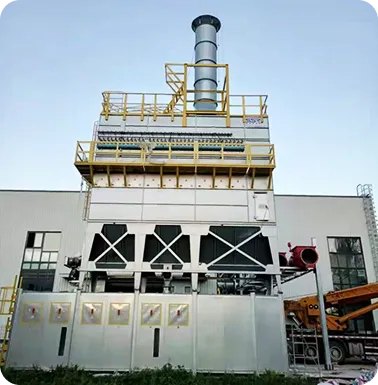
| Parameter | CC-Serie | CP-Serie |
| Models | CC30 / CC60 / CC90 / CC120 / CC150 | CP30 / CP60 / CP90 / CP120 / CP150 |
| Designed for | Medium and large-particle dust | Fine and ultrafine dust |
| Rated power | 30–150 kW | 30–150 kW |
| Airflow | 30.000–150.000 m³/h | 30.000–150.000 m³/h |
| Length | approx. 3,500–13,000 mm | approx. 3,500–13,000 mm |
| Width | approx. 2,400 mm | approx. 2,400 mm |
| Height | approx. 8,500 mm | approx. 7,000 mm |
| Operating noise | <80 dB | <80 dB |
| Emission target | <5 mg/m³ under suitable system conditions | <5 mg/m³ |
| Typical applications | Woodworking, furniture, metal fabrication, grinding, cement and building materials | Sanding, fine grinding, polishing, CNC, food powders, battery materials |
Two notes on reading that table. The emission target is conditional — “under suitable system conditions” means the figure describes the collector working inside a properly designed and maintained system, not a guarantee independent of stages one through five. And the height difference, roughly 1.5 m between the two platforms, is the row that most often decides indoor versus outdoor installation in an existing building.
Price is available on request based on system configuration and project requirements, since airflow, dust characteristics, layout, ducting, filtration and safety configuration all move the figure.
Where combustible material is involved, the working principle above intersects with NFPA 660 — Standard for Combustible Dusts and Particulate Solids, 2025 Edition (National Fire Protection Association), which consolidates fire and explosion requirements including the dust hazard analysis. OSHA publishes combustible-dust guidance under US general-industry regulations, and the ATEX framework (Directive 2014/34/EU, European Commission) applies to equipment for potentially explosive atmospheres in the EU. Senserui equipment is described as designed based on ATEX principles; product certificate numbers and issuing bodies are not published, and that distinction is worth holding onto with any supplier.
“A bigger fan fixes poor capture.” Capture is a hood geometry problem before it is an airflow problem. Adding fan power to a badly positioned hood increases energy cost and recovers a fraction of what repositioning would.
“Rising pressure drop means the filters are worn out.” It usually means the cake is not releasing. Worn media typically shows the opposite symptom — falling pressure drop with rising emissions.
“Clean filters filter best.” The cake does the fine work. Brand-new elements run at their least efficient during their first hours.
“The collector is the system.” The collector is one component among hoods, ducts, fan, cleaning control and discharge. Four of those five sit outside the machine you bought.
Compared with self-contained portable units that filter and recirculate air within the workspace, a centralized ducted system removes contaminant from the building and consolidates maintenance to one point. Running it that way brings:
That last item is the honest summary of the whole article. A dust collector does not usually break. It drifts.
A: A hood captures dust at the source, ducted airflow at a controlled velocity conveys it to the unit, filter media separates it from the airstream, periodic cleaning sheds the accumulated dust cake into a hopper, and a discharge system moves the material to storage while keeping air out.
A: It is the resistance across the filter media, and it tracks how much dust cake has built up. Rising pressure means the fan delivers less air, which reduces duct velocity and eventually capture. It is the earliest indicator that something is drifting.
A: On a surface-filtration collector, the dust cake on the media surface does most of the fine filtration. Clean media performs at its worst before a cake establishes.
A: On-demand cleaning triggered by differential pressure matches the cleaning rate to actual conditions, uses less compressed air and extends media life. Timed cleaning over-cleans in light production and under-cleans in heavy.
A: Yes. Over-cleaning strips the residual cake, so the unit filters at reduced efficiency for part of each cycle, consumes more compressed air and wears the media faster.
A: No. Mechanical shaking and vibration are alternatives — the compact S-Serie is published as using vibration-assisted ash cleaning. Confirm the method rather than assuming pulse-jet.
A: Usually the cascade described above: media loads, pressure rises, the fan’s operating point shifts, duct velocity falls, and the branches furthest from the collector lose capture first.
Something worth doing this week: find out whether your collector’s differential pressure is being recorded anywhere, and if so, look at the last twelve months of it. A flat line means it is not really being read. A rising line with no corresponding action is the cascade already underway. That single trend answers more questions about a dust system’s health than any inspection of the machine itself. If your process also releases solvent vapour, note that none of the five stages above touches it — vapour passes through particulate media, and adsorption is a separate system.