Für eine schnellere Antwort geben Sie bitte Ihre WhatsApp- oder Skype-Nummer in Ihre Nachricht ein, damit wir Sie so schnell wie möglich kontaktieren können.
Um uns eine schnellere Antwort zu ermöglichen, hinterlassen Sie bitte Ihre WhatsApp-Nummer, E-Mail oder Projektdetails. Wir antworten normalerweise innerhalb von 24 Stunden. Bei dringenden Anfragen kontaktieren Sie uns über WhatsApp: +8617862411260 oder WeChat: +8617862411260. Rufen Sie uns direkt an.
Tom | Founder, Senserui | Published: 25 August 2026 · Last reviewed: 25 August 2026 Technical review: Senserui Engineering Team
A cartridge type dust collector filters air through pleated media elements, packing several times the filtration area of a flat bag into the same housing volume. That geometry suits dry, fine, free-releasing dust. It works against you when the dust is fibrous, damp or oily, because pleats trap what pulse cleaning cannot release.
A cartridge collector uses cylindrical filter elements built from media folded into pleats. Dirty air passes from the outside of the element inward; particulate collects on the outer surface as a dust cake; clean air exits through the centre and out the clean-air plenum. Periodically, a pulse of compressed air fires down the element from the inside, flexing the media outward and dropping the cake into the hopper below.
The pleat is the entire point. Folding the media multiplies the surface area contained in a given cylinder, so a cartridge unit fits substantially more filtration area into a given footprint than an equivalent flat-media arrangement. That is why cartridge platforms became the default for fine-dust applications in buildings where floor area is expensive.
The same fold is also the failure mode, and almost nothing written about this equipment says so plainly.
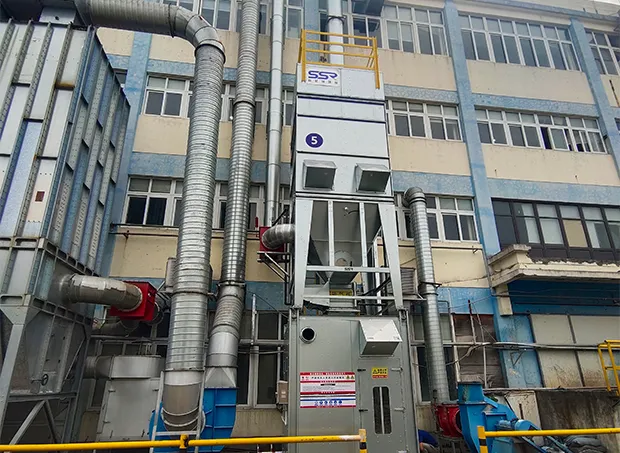
Filtration area is only useful if the dust cake releases when the pulse fires. A pleat has valleys. Anything that lodges in a valley and resists a downward pulse of air stays there.
So the relevant question about any dust is not “how fine is it” but “will the cake let go?” Three properties decide that:
When any of these are present, the symptom sequence is identical every time. Differential pressure across the media climbs. Airflow at the far end of the network drops. Capture at the machines degrades. Someone increases pulse frequency, which uses more compressed air and abrades the media without recovering airflow. Eventually the elements are replaced early, and the same dust does the same thing to the new set.
Differential-pressure monitoring is what turns that from a discovery into a trend line. It is a standard feature on the platform described further down, and it is worth checking on any unit under evaluation.
Six dust conditions that argue against a pleated platform, or at least against one without upstream treatment:
None of the first five are absolute. Each has an engineering answer — pre-separation, insulation, media selection, velocity control. The point is that each answer costs something, and a supplier who does not raise the question before quoting has not asked what you are actually collecting.
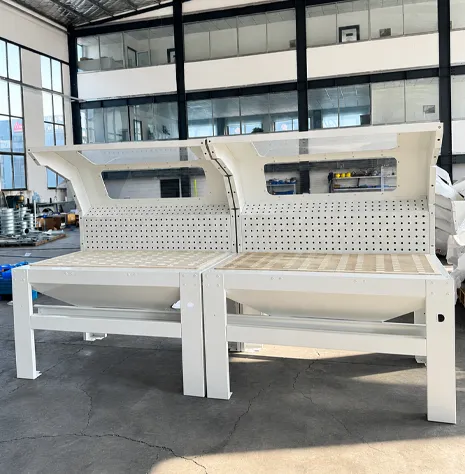
Dry, fine, free-releasing particulate is the target application, and it covers a lot of industrial ground: sanding, fine grinding, polishing, CNC processing, food powders, battery materials, pharmaceutical and electronics manufacturing.
Two secondary reasons plants choose the format:
Compared with the shaker-cleaned and reverse-air platforms common in high-load coarse applications, cartridge systems give up dust-holding capacity and tolerance for difficult material, and gain filtration area, emission performance and footprint. The comparison is genuinely application-dependent, which is why the abstract version of it that fills most search results never resolves into a recommendation.
The published figures for the fine-dust centralized platform, so the discussion above has something to anchor to.
| Parameter | Published figure |
| Models | CP30 / CP60 / CP90 / CP120 / CP150 |
| Rated power | 30–150 kW |
| Airflow | 30.000–150.000 m³/h |
| Equipment length | approx. 3,500–13,000 mm |
| Width | approx. 2,400 mm |
| Overall height | approx. 7,000 mm |
| Operating noise | <80 dB |
| Particulate emission target | <5 mg/m³ |
| Positioned for | Fine and ultrafine dust: sanding, fine grinding, polishing, CNC processing, food powders, battery materials |
| Monitoring | Differential-pressure monitoring; optional IoT-based system management |
| Price | Available on request based on system configuration and project requirements |
Length and width give the plan area directly:
| Model size | Length × Width | Plan area |
| Smallest published | 3,500 × 2,400 mm | approx. 8.4 m² |
| Largest published | 13,000 × 2,400 mm | approx. 31.2 m² |
Add service clearance on the element-access side and space for the discharge arrangement below; neither is included in the equipment dimension. The 7,000 mm overall height is the figure to check first in a retrofit — measure clear height under the lowest obstruction, whether that is a roof truss, a crane rail or a sprinkler main.
For comparison within the same catalogue, the coarse-particle CC-Serie shares the 30–150 kW and 30,000–150,000 m³/h ranges and the same length and width envelopes, but stands approximately 8,500 mm tall. Roughly 1.5 m separates the two platforms vertically, and in a low-eave building that difference decides indoor versus outdoor installation.
Below the centralized tier, the compact S-Serie covers 3–15 kW and 3,000–15,000 m³/h for fine-dust duty, with published dimensions ranging from approximately 2,000 × 1,200 × 3,200 mm to 2,100 × 2,100 × 6,000 mm. Worth noting on media-cleaning method: the S Series is published as using vibration-assisted ash cleaning rather than compressed-air pulse, which changes the compressed-air requirement and the cleaning behaviour. Confirm the cleaning method on any unit you evaluate rather than assuming pulse-jet.
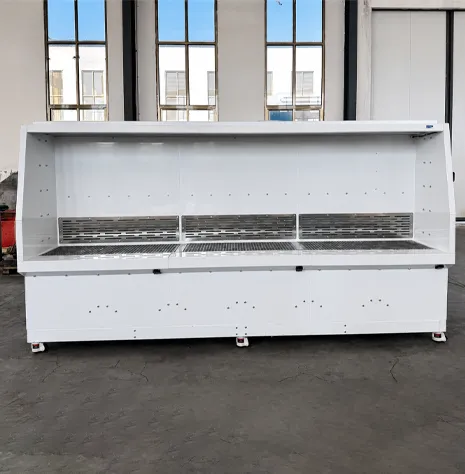
At workstation scale, the PW Series grinding dust collection table uses replaceable filter elements with an integrated fire-arresting structure, and the PD Series standalone grinding collector uses dedicated filter elements with a spark interception structure. Replaceable filter cartridges, explosion vents and valves are listed separately in the components line.
Reading a cartridge collector spec sheet, these are the rows that matter and the order to read them in:
That is six, because the noise figure gets forgotten and then becomes an occupational complaint after commissioning.
“Higher filtration area always means better performance.” Area helps only if the cake releases. On fibrous dust, more pleat area means more places for fibre to bridge.
“MERV or efficiency rating is the specification.” Efficiency describes the media. It says nothing about whether that media will stay clean in your airstream.
“Cartridges last a fixed number of years.” Element life is set by the dust, the cleaning cycle and the loading rate, not by a calendar. Two identical units in different plants can differ by a factor of several.
“If it blinds, increase pulse pressure.” Higher pulse pressure on blinded media abrades it and can drive particulate deeper into the pleat. It treats the symptom in the wrong direction.
“Cartridge versus baghouse is the decision.” The decision is dust characterisation. The platform follows from it, and a plant that runs the characterisation properly usually finds the answer is not close.
For a plant handling dry fine powder in a footprint-constrained building with an emission target to meet, those trade-offs are usually acceptable. For a plant collecting damp fibrous waste at high volume, they are not, and no amount of media specification fixes it.
A: A filtration unit using pleated cylindrical elements, cleaned by pulses of compressed air that flex the media and release the dust cake into a hopper. The pleated geometry gives more filtration area per unit of housing volume than flat media.
A: Fibrous material, moist or condensing airstreams, and oily or sticky particulate are the three clearest problems. High loading of coarse dust is a capacity issue rather than a blinding issue, and is usually addressed with pre-separation.
A: There is no calendar answer. Life depends on dust type, loading rate, cleaning frequency and airstream moisture. Differential-pressure trending is the practical way to know where you are rather than guessing.
A: Characterise the dust first. Dry, fine, free-releasing material with a footprint constraint points toward cartridges; heavy coarse loading, high moisture or fibrous content points away. The abstract version of this comparison cannot be resolved without the dust data.
A: 30,000–150,000 m³/h across five model steps, at 30–150 kW, with a published particulate emission target of <5 mg/m³ and operating noise below 80 dB.
A: Plan area runs from roughly 8.4 m² at the smallest published length to roughly 31.2 m² at the largest, before service clearance and discharge arrangement. Overall height is approximately 7,000 mm.
A: Available on request based on system configuration and project requirements, since airflow, dust characteristics, layout, ducting, filtration and safety configuration all move the figure.
The step that makes everything above actionable: get a sample of your actual dust characterised — particle size distribution, moisture content, fibre content, and combustibility if it applies. That report costs a fraction of one set of filter elements and it answers the platform question directly, rather than leaving you to arbitrate between supplier articles that each conclude in favour of what the supplier sells. If your process also releases solvent vapour, note that no dust filter addresses it; that is a separate adsorption question.
Senserui is an industrial environmental equipment manufacturer specializing in dust collection and VOC treatment systems. His work focuses on engineering-driven system design, modular standardization, manufacturing consistency, and the development of safer and more maintainable industrial air-pollution-control solutions. Senserui was founded in 2017 and manufactures from an approximately 10,000 m² production base in Qingdao, China, with in-house airflow, noise and filter testing before delivery. Technical review by the Senserui Engineering Team, covering system engineering, process planning, quality control, assembly and commissioning, after-sales support and IoT-based system operations.