Für eine schnellere Antwort geben Sie bitte Ihre WhatsApp- oder Skype-Nummer in Ihre Nachricht ein, damit wir Sie so schnell wie möglich kontaktieren können.
Um uns eine schnellere Antwort zu ermöglichen, hinterlassen Sie bitte Ihre WhatsApp-Nummer, E-Mail oder Projektdetails. Wir antworten normalerweise innerhalb von 24 Stunden. Bei dringenden Anfragen kontaktieren Sie uns über WhatsApp: +8617862411260 oder WeChat: +8617862411260. Rufen Sie uns direkt an.
Industrial plants, diesel engine rooms, and production lines release exhaust gas that can carry dust, VOCs, NOx, odor, and particulate matter. If these pollutants are not treated, they may lead to compliance risk, safety issues, and higher operating costs. A well-designed exhaust gas aftertreatment system solves this problem at the source.
An exhaust gas aftertreatment system is a group of equipment installed after combustion or production exhaust is generated. It uses filters, catalyst units, SCR, adsorption, thermal treatment, or gas purification technology to reduce harmful emissions before the gas stream is discharged. For factories, it supports cleaner air, safer operation, and easier environmental compliance.
Ein exhaust gas aftertreatment system treats exhaust gas after it leaves an engine, furnace, boiler, drying line, coating line, or industrial process. The goal is simple: reduce harmful emission levels before the exhaust gas reaches the outside air.
In many systems, the mainframe may include a filter, catalyst, SCR reactor, activated carbon unit, thermal oxidation chamber, fan, control cabinet, monitoring device, and safety protection system. For diesel engine exhaust, the system may also include a diesel particulate filter, oxidation catalyst, and urea dosing unit.
A modern exhaust gas treatment system is not one single machine. It is a complete process. The design depends on exhaust gas composition, airflow, temperature, humidity, dust load, VOC type, and local emission control standards.
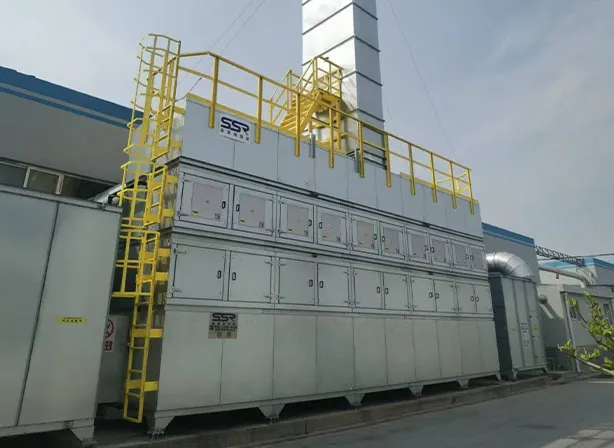
Exhaust gas may look invisible, but it can carry many noxious components. These include nitrogen oxide, particulate matter, VOCs, ammonia slip, acid gases, and fine dust. In a busy factory, untreated engine exhaust gas or process gas can affect workers, nearby communities, and equipment life.
Regulators are also tightening industrial emission control. For example, the revised EU Industrial Emissions Directive entered into force on August 4, 2024, with the goal of reducing harmful industrial emissions and protecting health and the environment.
For B2B buyers, exhaust gas treatment is not only about “clean air.” It is also about:
At Senserui China, we often see one common mistake: buyers focus only on the mainframe price. But the real value comes from correct engineering. If the exhaust gas flow, temperature of the exhaust gas, or dust concentration is miscalculated, even a good machine may perform poorly.
A catalyst helps a chemical reaction happen faster without being consumed quickly. In exhaust aftertreatment, catalyst modules are often used to reduce NOx, oxidize CO, remove hydrocarbons, or support VOC treatment.
There are different catalytic aftertreatment systems depending on the application. A diesel oxidation catalyst can help oxidize carbon monoxide and hydrocarbons. An SCR catalyst is used for nitrogen oxide reduction. A catalytic converter may be used in some engine exhaust applications. Catalytic oxidation may also be used in industrial VOC treatment.
The catalyst is powerful, but it is also sensitive. Poor gas purification design can poison or block the catalyst. Common problems include:
This is why an exhaust aftertreatment system should be engineered as a full line, not a random set of machines. The catalyst, filter, fan, duct, and cleaning system must work together.
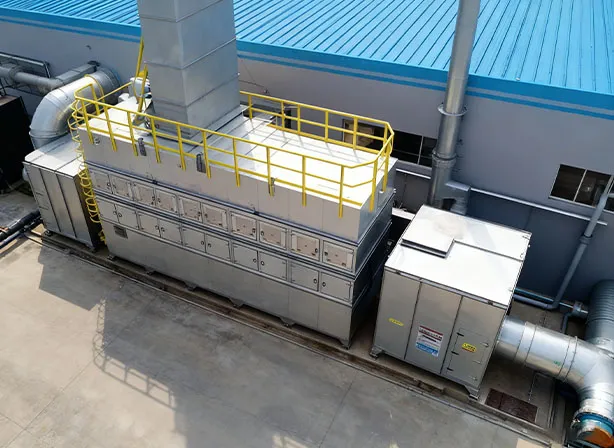
A filter removes solid particles from exhaust gas. In industrial dust collection, this may be a cartridge dust collector, baghouse, cyclone separator, or high-efficiency filter unit. In diesel exhaust, it may be a diesel particulate filter, also called a DPF.
A diesel particulate filter captures soot and particulate matter from diesel engine exhaust. CARB notes that a DPF, also known as a soot filter, is commonly used as a diesel emission control strategy and is evaluated for particulate matter or NOx emission reductions.
For diesel particulate filter systems, regeneration is very important. Regeneration burns accumulated particulate matter inside the filter so the pressure drop does not become too high. DieselNet explains that collected particulates are removed from the filter continuously or periodically through thermal regeneration.
For industrial exhaust gas, filtration also protects downstream equipment. If particulate enters an SCR catalyst, activated carbon bed, or catalytic oxidation unit, it may cause clogging and pressure loss. Good pre-filtration reduces maintenance cost and improves system stability.
Not all exhaust gas comes from diesel engines. Many factories release VOCs, odor, oil mist, and solvent vapor from painting, coating, printing, rubber, plastics, electronics, chemical processing, and furniture production. These gases often need a different treatment process.
For VOC exhaust treatment, common solutions include:
Natural gas combustion may produce lower particulate emissions than diesel, but it can still release NOx, CO, and unburned hydrocarbons depending on combustion conditions. So the exhaust gas treatment system should be selected based on real gas testing, not only fuel type.
For mixed exhaust gas, Senserui China often recommends a staged design. First remove dust and particulate. Then treat VOCs or odor. Finally, use catalyst, thermal oxidation, or adsorption polishing if required. This protects the system and keeps performance stable.
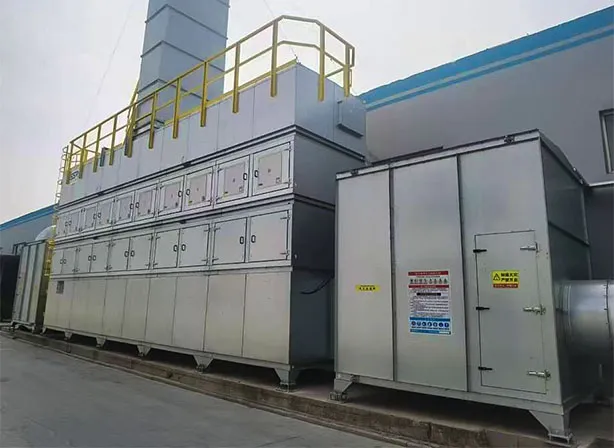
Senserui China is an industrial dust collection and VOCs treatment manufacturer in China. We serve medium- and large-scale manufacturers, environmental engineering contractors, system integrators, distributors, and importers.
Our strength is not only equipment supply. We focus on full exhaust gas treatment system design, including dust collection, VOC control, emission control, modular layout, fire prevention, explosion protection, and remote after-sales support.
For overseas B2B customers, we understand the real concerns:
Senserui China provides factory-direct supply and engineering support for industrial exhaust gas, dust, VOC, odor, and mixed gas treatment projects. If you are planning a new factory, upgrading an old line, or helping your client pass environmental inspection, we can help you build a practical solution.
An exhaust gas treatment system can refer to any system that treats industrial exhaust gas, VOCs, odor, dust, or combustion gas. An exhaust aftertreatment system usually refers to equipment installed after an engine or combustion process, such as SCR, catalyst, or particulate filter units.
Not always. It depends on the engine type, power rating, local emission rules, fuel, and NOx target. Some diesel engine exhaust systems may need SCR, while others may use a diesel oxidation catalyst, diesel particulate filter, or combined exhaust aftertreatment system.
An SCR catalyst may fail because of dust blockage, catalyst poisoning, poor urea dosing, low exhaust gas temperature, oil contamination, or uneven exhaust gas flow. Good pre-filtration and correct system design help extend catalyst life.
Yes, but it usually needs a combined system. For example, dust should be removed before VOC adsorption or catalytic treatment. NOx may require SCR. The best design depends on exhaust gas composition and emission target.
You should provide exhaust gas flow, temperature, pollutant type, concentration, humidity, operating hours, emission target, installation space, and photos or drawings of the site. This helps the supplier design the correct aftertreatment system.
Activated carbon can work well for many low- to medium-concentration VOC applications. However, high concentration, high humidity, high temperature, or sticky VOCs may require pre-treatment, catalytic oxidation, thermal oxidation, or a combined system.