Daha hızlı bir yanıt almak için lütfen mesajınıza WhatsApp veya Skype'ınızı ekleyin, böylece sizinle mümkün olan en kısa sürede iletişim kurabiliriz.
Hızlı cevap vermemize yardımcı olmak için lütfen WhatsApp, e-posta veya proje detaylarınızı bırakın. Genellikle 24 saat içinde yanıt veririz. Acil talepler için, WhatsApp üzerinden bizimle iletişime geçin: +8617862411260 veya WeChat: +8617862411260. doğrudan arayın.
A self contained dust collector is a system that filters dust-laden air, stores the captured material, and discharges it from one integrated unit, without a separate silo or conveyor. At industrial scale, this usually means a filtration mainframe paired with a built-in dust bin sized in cubic meters, not drums.
The term covers two very different classes of equipment. In a small shop, a self contained collector is usually a free-standing bag or cartridge unit with collection drums or bags underneath. It is moved by hand and emptied by hand, often several times a day.
A furniture plant running dozens of sanders, CNC routers and panel saws has different needs. The collector handles tens of thousands of cubic meters of air per hour. If dust still ends up in drums at that scale, someone spends a large share of each shift emptying them. An industrial self contained system solves this by building the storage into the collector installation itself. The dust bin is sized to hold hours or days of production, and it has a discharge point a truck or container can reach.
So at industrial scale, “self contained” describes a system boundary. Air goes in dirty and leaves filtered, and the dust leaves only when you schedule its removal.
The main argument is fewer moving parts between the filter and the truck. A separate silo needs a transfer system to move dust from the collector hopper to the silo, usually a screw conveyor, a rotary valve or a pneumatic line. Each transfer point needs maintenance, can block, and has to be included in the fire and explosion protection plan. An integrated bin removes some or all of that transfer stage.
Footprint planning is also simpler. The bin is designed alongside the mainframe, so foundation, access and service clearances are planned once.
The limitations are real:
Bin size decides how often you empty the system. This calculation matters more than any brochure figure, and you can do it yourself.
Emptying interval (hours) = Usable bin volume (m³) ÷ Loose dust generation rate (m³/h)
Measure your own dust. Wood dust volume depends heavily on the process. Fluffy sanding dust and long planer shavings take up very different space per kilogram.
| Bin volume | Usable volume | At 1 m³/h | At 2 m³/h | At 4 m³/h | |
| 25 m³ | 20 m³ | 20 h | 10 h | 5 h | |
| 50 m³ | 40 m³ | 40 h | 20 h | 10 h | |
| 94 m³ | 75.2 m³ | 75 h | 37.6 h | 18.8 h |
The table shows how sharply the interval changes. A plant producing 4 m³/h of loose dust fills even the largest bin in under one day. If two shifts run on a heavy sanding schedule, the bin may need emptying every day. Measure first, then size the bin.
Senserui’s MS Series is a rectangular integrated dust bin designed to work with its centralized dust collection mainframes. Woodworking plants usually pair it with CC Series units (medium and large particles) or CP Series units (fine and ultrafine dust).
| Parameter | MS Series (MS30–MS150) |
| Storage capacity | 25–94 m³ |
| Equipment length | approx. 3,500–13,000 mm |
| Width | approx. 2,400 mm |
| Discharge height | approx. 3,100 mm |
| Safety features | Explosion relief, fire suppression, temperature monitoring, water-pressure monitoring |
| Price | Available on request based on system configuration and project requirements |
The published length and width ranges match those of the CC, CP and CZ mainframes. This reflects the design intent to share one planned footprint with the collector. Confirm the exact pairing and layout for your model on the project drawings. Per-model capacity values come with project technical data and are not listed here.
Check the 3,100 mm discharge height against your actual collection vehicle or container before ordering. This is easy to overlook. A mismatch here creates daily handling problems that are expensive to fix after installation.
At company level, Senserui states that its explosion-protection design follows ATEX principles.
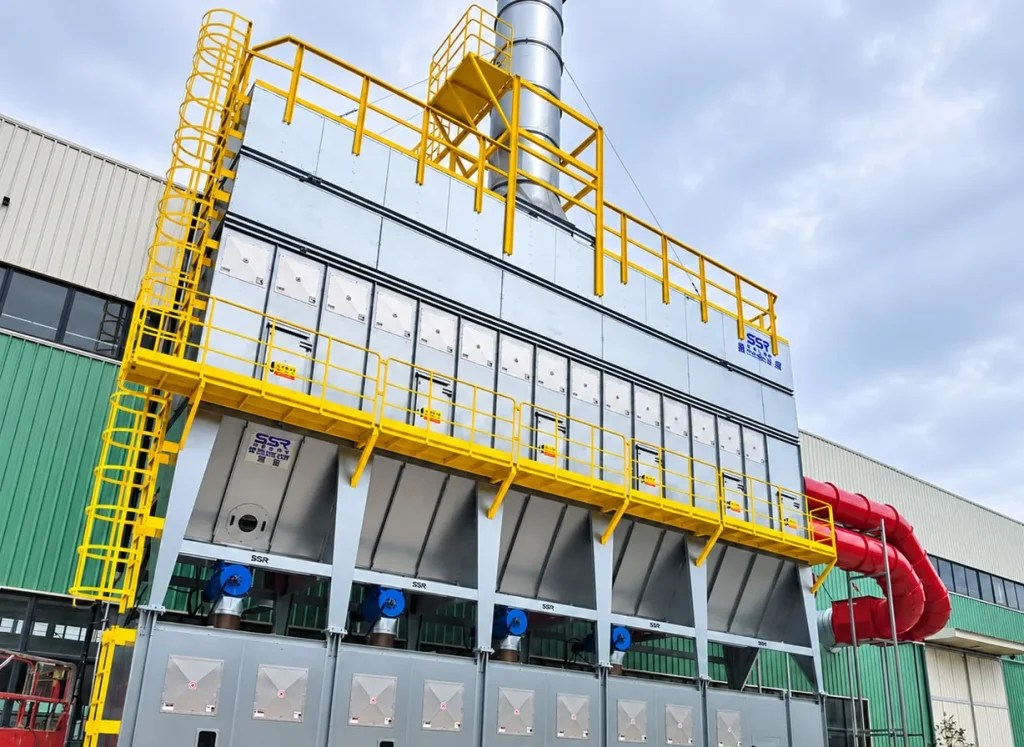
Compared with the tower silos and drum/bag hoppers commonly used in woodworking dust systems, an integrated bin trades height for length:
| Factor | Drum / bag under hopper | Integrated bin (e.g., MS Series) | Modular tower silo (e.g., Senserui DC Series) |
| Typical storage scale | Small; containers emptied by hand | 25–94 m³ | 30–100 m³ |
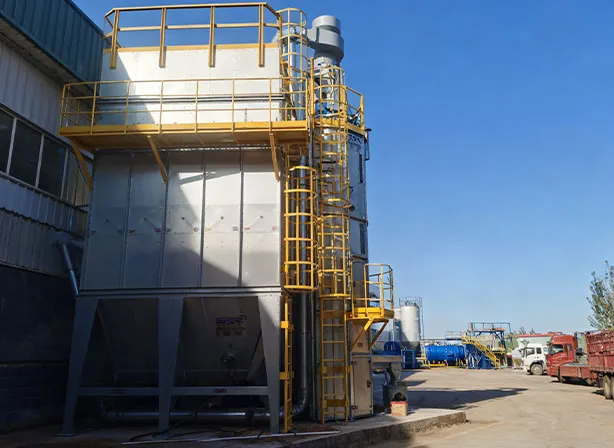
| Shape | Under the collector | Rectangular, horizontal; width approx. 2,400 mm | Vertical; diameter 2,400–4,500 mm, height 10,000–18,000 mm |
| Emptying | Manual, frequent | Scheduled discharge to vehicle or container | Scheduled discharge; powered (rated 5–15 kW) |
| Main site constraint | Labor time | Ground length | Height and foundation for a tall structure |
| Best fit | Single-machine or light-duty shops | Centralized systems where long ground space is available and a tall structure is impractical | Sites with limited ground area that can accommodate height |
The capacity ranges of the two larger options overlap almost completely. So the choice between an integrated bin and a tower silo is usually about site geometry, local height restrictions and how dust reaches the storage, not about volume.
A supplier can only size the system accurately if you bring real data:
Is a self contained dust collector the same as a portable dust collector?
Not necessarily. Many portable units are self contained, but industrial self contained systems are fixed installations with integrated storage measured in cubic meters. The common feature is that filtration and dust storage are in one system, not mobility.
How often does an integrated dust bin need to be emptied?
Divide usable bin volume by your loose dust generation rate. A 25 m³ bin at 80% usable fill lasts 10 hours at 2 m³/h. The same bin lasts 20 hours at 1 m³/h. Your measured rate determines the answer.
Can an integrated bin handle fine sanding dust?
Yes. In woodworking, the bin is commonly paired with a fine-dust mainframe such as Senserui’s CP Series. Fine dust can compact during long storage, so plan emptying intervals around your pickup cycle rather than maximum bin capacity.
What safety features should an integrated dust bin have?
The MS Series includes explosion relief, fire suppression, temperature monitoring and water-pressure monitoring. Your site’s dust hazard analysis, referencing standards such as NFPA 660, should determine the final protection package.
How much does an integrated dust bin system cost?
Senserui does not publish fixed prices. Price is available on request because it depends on airflow, dust characteristics, layout, ducting, safety requirements and automation level.