For a faster response, please include your WhatsApp or Skype in your message so we can contact you as soon as possible.
To help us respond faster, please leave your WhatsApp, email, or project details. We usually reply within 24 hours. For urgent inquiries,contact us on WhatsApp: +8617862411260 or WeChat: +8617862411260. call us directly.
No single dust collection system qualifies as universally best. Fit depends on three variables: dust particle size and composition, the simultaneity factor across connected workstations, and the combustible dust safety classification of the material being processed.
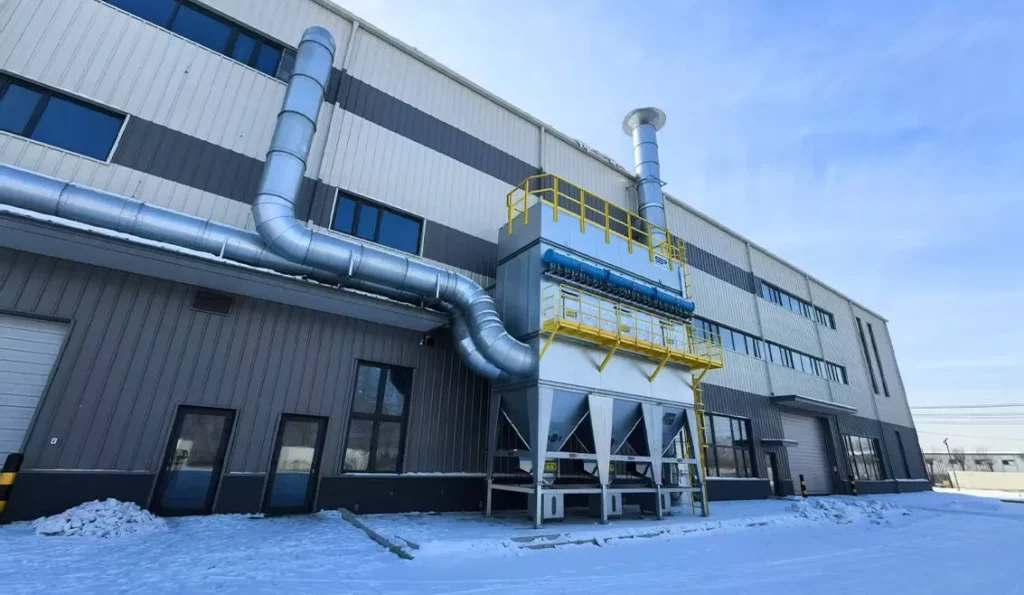
A woodworking shop running five sanders at once has a different load profile than a metal fabrication line running two welding booths and a grinding station intermittently. A generic system with a fixed CFM rating and no configuration logic behind it will either be undersized for the shop that needs it or oversized — and paid for — by the one that doesn’t.
Three variables decide fit, in this order of priority.
Medium and large particulate — wood chips, weld spatter debris, coarse metal grindings — behaves differently in a filtration system than fine or ultrafine particulate from sanding, polishing, or powder handling. Fine dust clogs filter media faster and requires tighter emission control; coarse dust puts more mechanical load on ducting and separation stages.
This is the number of workstations expected to draw suction at the same time, divided by the total number of connected stations. A shop with ten grinding points where three typically run together has a simultaneity factor of roughly 0.3. Sizing a mainframe to the sum of all ten stations’ peak draw instead of the simultaneous load is the single most common oversizing mistake in industrial dust collector selection.
Wood dust, some metal dusts, and certain organic powders carry ignition and explosion risk under specific concentration and particle-size conditions. NFPA 660 is the consolidated standard covering fire and explosion hazards from combustible dusts and particulate solids, and it is the reference point for determining whether a process needs spark detection, explosion relief, or isolation hardware built into the mainframe rather than added later.
| Parameter | CC Series | CP Series | CZ Series |
|---|---|---|---|
| Rated Power | 30–150 kW | 30–150 kW | 30–150 kW |
| Airflow | 30,000–150,000 m³/h | 30,000–150,000 m³/h | 30,000–150,000 m³/h |
| Equipment Length | ~3,500–13,000 mm | ~3,500–13,000 mm | ~3,500–13,000 mm |
| Width | ~2,400 mm | ~2,400 mm | ~2,400 mm |
| Height | ~8,500 mm | ~7,000 mm | ~8,500 mm |
| Published Noise | <80 dB | <80 dB | ≤80 dB |
| Particulate Emission Target | <5 mg/m³ under suitable system conditions | <5 mg/m³ under suitable system conditions | Not published |
| Designed For | Medium/large-particle dust | Fine and ultrafine dust | Metalworking with spark and fume load |
| Safety Features | Standard system monitoring | Standard system monitoring | Spark detection, chain-break detection, explosion relief, emergency stop |
| Typical Fit | Woodworking, furniture, general metal fabrication, cement/building material processing | Sanding, fine grinding, polishing, CNC, food powder, battery material handling | Welding, cutting, grinding, polishing, heavy metal fabrication |
The three series share the same power and airflow envelope. What separates them is filtration targeting and, for the CZ Series, the safety hardware built in for spark-producing processes. A shop mixing welding and fine polishing on the same floor is a case for evaluating two mainframes rather than forcing one series to cover both load types.
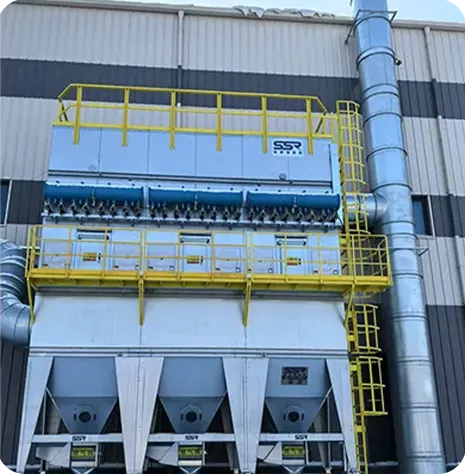
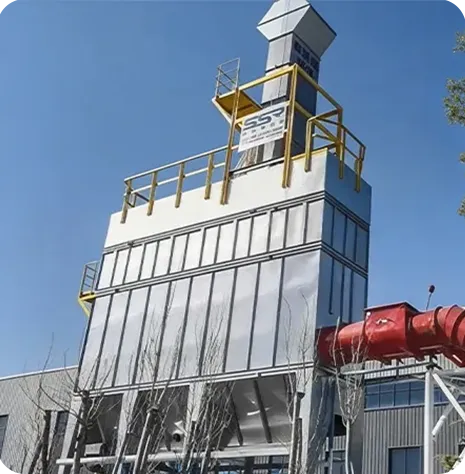
Oversizing airflow past what a duct network and filter media are designed for does not add a safety margin. It increases velocity past optimal separation range in some filtration stages, raises energy cost without raising capture efficiency, and can pull more fine particulate past the filter media than a correctly sized system would. Fit-scoring against simultaneity factor exists specifically to avoid this — not to trim cost, but to keep the system operating inside its designed separation range.
A centralized mainframe sized to simultaneity factor, compared to a fixed-capacity single-rating system, requires more upfront calculation work — floor mapping, station-by-station CFM data, and duct static pressure figures. That calculation step is a real cost in engineering time before a system is ever ordered. What it buys back is a mainframe that isn’t running near-idle most shifts and spiking to overload during peak production, which is the more common failure mode in shops that sized off peak-draw totals rather than realistic concurrency.
The CZ Series‘ explosion relief and spark detection hardware is designed based on ATEX principles, per Senserui’s published system documentation. That is not the same claim as ATEX certification, and no certificate number is published for the series — worth confirming with the supplier directly if a specific project requires certified documentation.
CC targets medium/large-particle dust across general industrial applications. CP targets fine and ultrafine particulate. CZ adds spark detection, chain-break detection, explosion relief, and emergency-stop protection for metalworking processes that generate sparks alongside dust.
Walk the floor during a representative peak shift and count how many dust-generating stations are drawing suction at the same moment, then divide by total connected stations. A rough estimate from direct observation is more useful than a theoretical assumption.
The CP and CZ series are built around different filtration and safety targets. A shop running both process types should evaluate whether two separate mainframes, or a CZ-based system with supplementary fine filtration, fits the layout better than forcing one series to cover both dust types.
It depends on the specific metal, particle size, and concentration involved. NFPA 660 is the reference standard for determining combustible dust classification; a dust hazard analysis against that standard is the correct way to confirm whether spark detection and explosion relief are required for a given process.
Senserui does not publish fixed prices for the CC, CP, or CZ series. Pricing depends on rated power, airflow target, safety classification, and ducting configuration, and is quoted per project.
The mainframe gets undersized against actual concurrent load, which shows up as inconsistent suction at individual workstations during peak production — the same symptom oversizing is meant to prevent, from the opposite direction.