Für eine schnellere Antwort geben Sie bitte Ihre WhatsApp- oder Skype-Nummer in Ihre Nachricht ein, damit wir Sie so schnell wie möglich kontaktieren können.
Um uns eine schnellere Antwort zu ermöglichen, hinterlassen Sie bitte Ihre WhatsApp-Nummer, E-Mail oder Projektdetails. Wir antworten normalerweise innerhalb von 24 Stunden. Bei dringenden Anfragen kontaktieren Sie uns über WhatsApp: +8617862411260 oder WeChat: +8617862411260. Rufen Sie uns direkt an.
Tom | Founder, Senserui | Published: 19 August 2026 · Last reviewed: 19 August 2026 Technical review: Senserui Engineering Team
Designing an industrial dust collection system runs in a fixed order: characterise the dust, size each pickup point, set duct transport velocity, total the airflow and static pressure, select the collector, then configure explosion protection and discharge. Skipping the order is what produces underperforming systems. This guide walks the sequence with the numbers behind each step.
Most furniture plants begin the conversation with a fan size or a collector model number. That is the last decision in the sequence, not the first.
What the design actually depends on is the material moving through the duct. For a woodworking or furniture operation, five properties change the outcome:
A plant that runs both a wide-belt sander and a rip saw on the same header is dealing with two different dusts. That single fact drives most of the decisions further down this page.
Branch airflow is not a guess and it is not a lookup table. It is arithmetic:
Q = v × A
Where Q is volumetric flow (m³/h), v is the transport velocity required for the dust class (m/s), and A is the cross-sectional area of the connection (m²), calculated as π × d² / 4.
Applying a 20 m/s transport velocity — a common starting point for dry wood dust and chips — to standard port diameters gives the following branch flows:
| Port diameter | Duct area | Branch flow at 20 m/s | Branch flow at 22 m/s |
| 100 mm | 0.0079 m² | 565 m³/h | 622 m³/h |
| 125 mm | 0.0123 m² | 883 m³/h | 972 m³/h |
| 150 mm | 0.0177 m² | 1,272 m³/h | 1,399 m³/h |
| 200 mm | 0.0314 m² | 2,262 m³/h | 2,488 m³/h |
| 250 mm | 0.0491 m² | 3,534 m³/h | 3,888 m³/h |
| 300 mm | 0.0707 m² | 5,089 m³/h | 5,598 m³/h |
Two cautions on that table. First, the port diameter fitted by the machine builder is a starting assumption, not an instruction — an undersized factory port on a heavy chip producer should be corrected at the hood, not accepted and designed around. Second, the velocity figures above are planning values for dry wood dust; damp shavings, mixed metal-and-wood streams and heavier building-material dusts all sit higher, and the required conveying velocity should be confirmed for the actual material before the duct diameters are frozen.
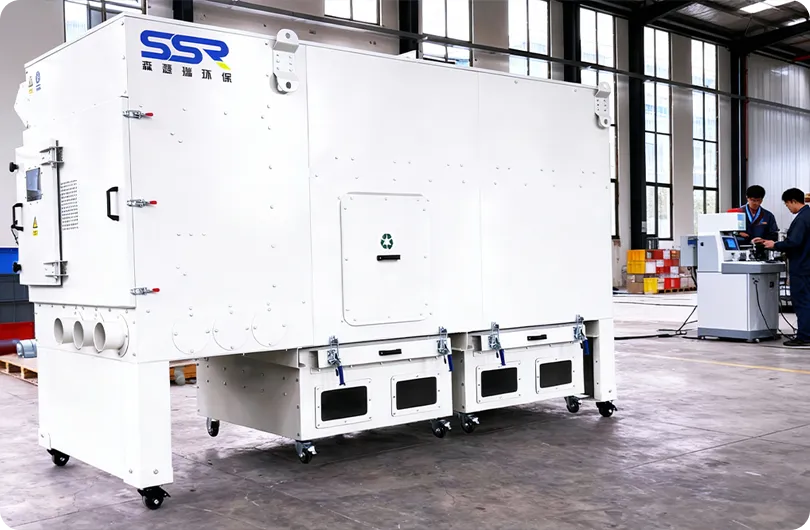
Undersize the velocity and material drops out of the airstream inside the duct. In a wood plant, settled dust in a horizontal run is fuel sitting inside a confined volume with an ignition path leading to it. Oversize the velocity and friction loss climbs steeply, which shows up as fan power on the electricity bill for the life of the system, plus accelerated abrasion at elbows.
The band is narrower than people expect. There is real design work in staying inside it across a network that may have twenty branches feeding one main.
This is the working sequence. Each step has a completion test, so a plant engineer can check whether it has actually been finished rather than half-done.
Steps 4 and 6 are where most designs quietly go wrong, and both failures are invisible until the system is commissioned and one machine at the end of the run is not picking up.
Senserui’s centralized mainframes split along the coarse/fine line described earlier, which is the same split a furniture plant sees between its machining side and its sanding side.
| CC-Serie | CP-Serie | |
| Models | CC30 / CC60 / CC90 / CC120 / CC150 | CP30 / CP60 / CP90 / CP120 / CP150 |
| Designed for | Medium and large-particle industrial dust | Fine and ultrafine industrial dust |
| Rated power | 30–150 kW | 30–150 kW |
| Airflow | 30.000–150.000 m³/h | 30.000–150.000 m³/h |
| Equipment length | approx. 3,500–13,000 mm | approx. 3,500–13,000 mm |
| Width | approx. 2,400 mm | approx. 2,400 mm |
| Height | approx. 8,500 mm | approx. 7,000 mm |
| Published operating noise | <80 dB | <80 dB |
| Published particulate emission target | <5 mg/m³ under suitable system conditions | <5 mg/m³ |
| Typical applications | Woodworking, furniture production, metal fabrication, grinding, cement and building-material processing | Sanding, fine grinding, polishing, CNC processing, food powders, battery materials |
The height row is the one that changes building decisions. Roughly 1.5 m separates the two series, and in a retrofit into an existing furniture workshop with a low eave line, that gap decides whether the mainframe goes indoors or onto an external pad with weather protection and a longer duct run. Check it before the layout is drawn, not after.
Both series cover the same 30,000–150,000 m³/h span in five model steps, so a plant whose calculated design flow lands at, say, 88,000 m³/h should confirm the specific model figures rather than interpolating from the range endpoints. Where a shop’s total is well under 30,000 m³/h, the compact S-Serie (3–15 kW, 3,000–15,000 m³/h) covers fine-dust applications, and the W-Serie (1.1–3 kW, 700–2,000 m³/h, approx. 700 × 350 × 1,360 mm) handles a single welding, grinding or finishing station rather than a network.
Pricing: available on request, based on system configuration and project requirements. Configuration depends on airflow, dust characteristics, plant layout, ducting, filtration selection, safety requirements and automation level, so a per-model list price would not survive contact with an actual project.
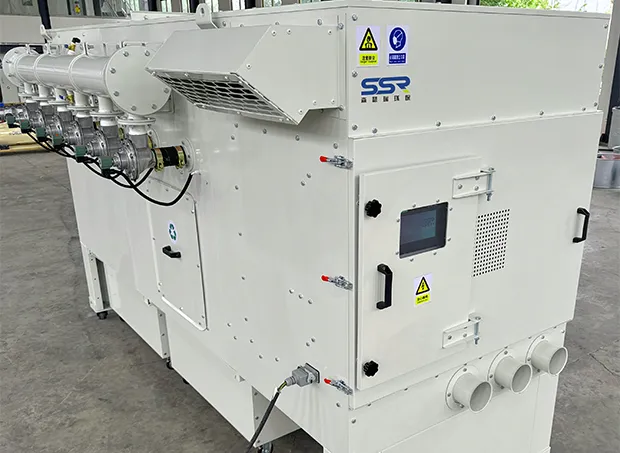
Collected wood dust and chips have to go somewhere, at a rate matched to production. Two published options:
MS Series integrated dust bin — rectangular silo, 25–94 m³ storage, length approx. 3,500–13,000 mm, width approx. 2,400 mm, discharge height approx. 3,100 mm, with explosion relief, fire suppression, temperature monitoring and water-pressure monitoring among the stated safety features. The 3,100 mm discharge height is a hard planning input: it must clear the container or truck bed that will collect the material.
DC Series modular tower silo — 5–15 kW, 30–100 m³ storage, diameter 2,400–4,500 mm, height 10,000–18,000 mm. The product page states the system is designed with reference to relevant national and EU standards; a specific product certificate number is not published.
Tower silos buy volume without floor area, which suits plants that have already filled their yard. They also introduce a foundation and a crane lift into the installation programme.
Explosion protection is a design input, not an accessory list added at quotation stage.
The EU ATEX framework (Directive 2014/34/EU, European Commission) governs equipment and protective systems intended for use in potentially explosive atmospheres, and it is the reference point for plants selling into or operating within the EU. Senserui equipment is described as designed based on ATEX principles; where a project requires certified equipment, the corresponding certificate should be requested and reviewed rather than inferred from a design statement.
In the United States, OSHA publishes standards and guidance addressing combustible-dust hazards under general-industry regulations, and NFPA 660 (2025 Edition) consolidates the technical requirements — dust hazard analysis, explosion protection, housekeeping and equipment provisions — into a single standard.
What this translates into on the equipment list for a furniture plant: explosion relief on the collector and the silo, spark detection where the process can generate ignition sources, isolation between the collector and the building, temperature monitoring, and a housekeeping plan for the dust that will inevitably escape capture. The CZ Series, positioned for metalworking, additionally lists chain-break detection and emergency-stop protection — relevant where a plant runs mixed wood and metal operations under one roof.
Sizing the collector for today’s machine list. Furniture plants add machines. A system designed with zero headroom needs a second collector within a few years, and the second collector is more expensive than the headroom would have been.
Treating the simultaneity factor as free money. Closing blast gates reduces required airflow, which is the correct engineering move. It also means those branches contain still air with dust in them. NFPA 660’s approach to combustible particulate solids does not stop at the collector; settled material in a dead branch is part of the hazard picture. Gate strategy and housekeeping have to be designed together.
Calculating static pressure at clean-filter condition. Filter resistance rises through the cleaning cycle. A fan selected against clean-filter SP will lose airflow steadily as the media loads, and the symptom — the machine furthest from the collector stops picking up — gets blamed on the duct.
Assuming a single collector suits mixed dust. Running heavy planer chips and fine sanding dust into one filtration section shortens media life on the fine side and can cause bridging on the coarse side. Separating the networks, or selecting for the harder of the two duties, costs more at purchase and less over five years.
Reading “designed based on ATEX principles” as “ATEX certified”. These are different statements. Ask for the document.
The case for a centralized mainframe over the individual bag-type units still common in smaller woodworking shops: one filtration point instead of twenty, dust removed from the workshop volume rather than filtered and returned into it, published emission targets, and a single maintenance schedule.
The case against, stated plainly:
Compared with the general “factors to consider” checklists published on most equipment category pages, the arithmetic above will not tell you which model to buy. It will tell you whether the number a supplier proposes is defensible, which is the more useful thing to know before a quotation arrives.
A: Dry wood dust and chips are commonly designed around 20–22 m/s as a starting point, with the figure confirmed against the actual material. Damp shavings and mixed streams sit higher. The band matters in both directions: too low and material settles in the duct, too high and friction loss and fan power climb.
A: Multiply the connection’s cross-sectional area by the transport velocity. A 150 mm port at 20 m/s needs about 1,272 m³/h. Verify the port size is appropriate for the process rather than assuming the machine builder sized it for your dust load.
A: CC Series is positioned for medium and large-particle dust — sawing, machining, planing. CP Series is positioned for fine and ultrafine dust — sanding, polishing, CNC. Plants running both should have the split assessed rather than defaulting to one unit for the whole floor.
A: The publicly available wording is that explosion protection is designed based on ATEX principles. Certificate numbers, issuing bodies and notified-body references are not published for individual products. If a project requires certified equipment, request the specific documentation.
A: Price is available on request based on system configuration and project requirements. Airflow, dust characteristics, layout, ducting, filtration and safety configuration all move the number, so no fixed per-model price is published.
A: Work from kilograms of waste per hour and the collection interval you can live with, not from collector size. MS Series covers 25–94 m³; DC Series tower silos cover 30–100 m³ with a smaller footprint and a taller structure.
Next step, rather than a summary: take your machine list, fill in the port diameters, and run the Q = v × A calculation for every branch this week. The total you arrive at is the single number that makes every subsequent supplier conversation concrete. If the plant also runs a finishing or coating line, VOC treatment is a parallel design track with its own capture, residence-time and adsorption-media questions that this guide does not cover.
Senserui is an industrial environmental equipment manufacturer specializing in dust collection and VOC treatment systems. His work focuses on engineering-driven system design, modular standardization, manufacturing consistency, and the development of safer and more maintainable industrial air-pollution-control solutions. Senserui was founded in 2017 and operates an approximately 10,000 m² production base in Qingdao, China. Technical review by the Senserui Engineering Team, which covers system engineering, process planning, quality control, equipment assembly and commissioning, after-sales support and IoT-based system operations.