Für eine schnellere Antwort geben Sie bitte Ihre WhatsApp- oder Skype-Nummer in Ihre Nachricht ein, damit wir Sie so schnell wie möglich kontaktieren können.
Um uns eine schnellere Antwort zu ermöglichen, hinterlassen Sie bitte Ihre WhatsApp-Nummer, E-Mail oder Projektdetails. Wir antworten normalerweise innerhalb von 24 Stunden. Bei dringenden Anfragen kontaktieren Sie uns über WhatsApp: +8617862411260 oder WeChat: +8617862411260. Rufen Sie uns direkt an.
Industrial exhaust gas can look invisible, but the cost is real. Odor complaints, VOCs emission risk, unstable airflow, and maintenance pressure can hurt production. A modular HAC exhaust gas treatment mainframe gives factories a cleaner, more flexible way to control exhaust gas.
The HAC modular standard exhaust gas treatment mainframe is an industrial VOCs purification system that uses high-iodine honeycomb activated carbon, modular airflow design, and multi-fan operation to adsorb solvent-based VOCs from industrial exhaust gas. It is suitable for spray booths, coating lines, printing, chemical workshops, and other VOCs control projects.
Das HAC modular standard exhaust gas treatment mainframe is a VOCs adsorption and gas purification unit designed for industrial exhaust gas. It is used when a factory needs to treat organic solvent vapor, odor, or low-to-medium concentration VOCs before discharge.
The main idea is simple. Industrial exhaust gas enters the mainframe. The gas passes through honeycomb activated carbon. VOCs molecules are adsorbed inside the carbon pores. Cleaner gas then leaves the system. The treated air can help the factory reduce emission risk and improve the surrounding work environment.
For Senserui China, HAC is not just a box with carbon inside. It is a modular purification system built around airflow, contact time, carbon capacity, pressure balance, maintenance access, and project customization. Overseas buyers often care about emission standards, stable operation, energy use, carbon replacement, and after-sales support. These are exactly the details that decide whether an exhaust gas treatment project works well in real production.
Das HAC series exhaust gas treatment mainframe uses a clear treatment path. First, the exhaust gas is collected from the source, such as spray booths, coating rooms, printing machines, drying tunnels, glue application areas, or chemical operation points. Then fans move the gas into the purification chamber.
Inside the mainframe, the exhaust gas passes through high-iodine honeycomb activated carbon. The carbon adsorbs VOCs from the gas stream. This process is physical adsorption, not combustion. It is often used for solvent vapor and odor control when the gas concentration, temperature, humidity, and particle content are suitable.
A typical HAC working flow looks like this:
Industrial VOCs Source
↓
Collection Hood / Ductwork
↓
Pre-Filter or Particle Protection
↓
HAC Exhaust Gas Treatment Mainframe
↓
Honeycomb Activated Carbon Adsorption
↓
Multi-Fan Airflow Control
↓
Cleaner Gas Discharge
↓
Carbon Replacement / Maintenance
In short, the exhaust gas treatment mainframe uses high-iodine activated carbon to adsorb VOCs, while the modular multi-fan design helps the system keep stable airflow under industrial working conditions.
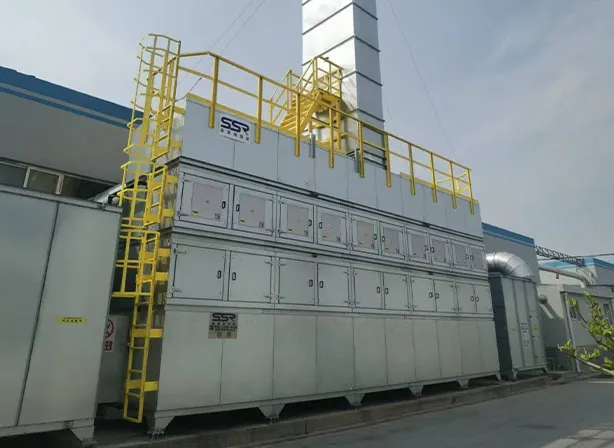
A modular exhaust gas treatment mainframe gives buyers flexibility. Instead of designing every unit from zero, modular equipment can be planned with standard sections, fans, carbon modules, access doors, duct interfaces, sensors, and control panels. This makes project design faster and installation easier.
A modular system also supports future expansion. If a factory adds another spray booth or coating line, the system may be expanded or adjusted more easily than a fully fixed custom-only structure. This is useful for medium- and large-scale manufacturers that plan phased production growth.
Key benefits of modular design include:
For overseas buyers, modular design also saves additional costs in communication, shipping, installation, and maintenance planning. A clear standard structure helps all parties understand the system before delivery.
VOCs control focuses on volatile organic compounds. These are organic chemicals that can evaporate into the air. Solvent, paint, ink, adhesive, and cleaning agent processes often release VOCs. HAC uses activated carbon adsorption to capture these gases.
SCR means selective catalytic reduction. It is mainly used to reduce NOx, also called nitrogen oxides. In SCR systems, a reducing agent such as urea solution can react with nitrogen oxides over a catalyst and convert them into water and harmless nitrogen, often written as N2. This is common in diesel engine and industrial combustion emission control.
Catalytic treatment is a broader term. It may include a catalytic converter, catalytic oxidation, or SCR catalytic converter. In VOCs projects, catalytic oxidation can destroy VOCs through oxidation at a controlled temperature. In engine aftertreatment, catalytic systems may treat NOx, CO, hydrocarbons, and diesel exhaust pollutants.
The key point is simple:
Senserui China can help buyers evaluate whether activated carbon, catalytic treatment, or another purification route fits the exhaust gas condition.
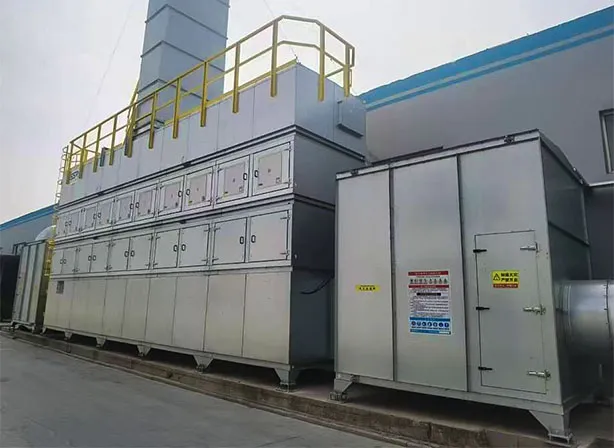
Das HAC mainframe can use a multi-fan layout to support stable airflow and modular operation. In many factories, exhaust volume changes during the day. Some lines run at full capacity. Some lines stop. Some spray booths work in batches. A single fixed fan may not always match these changing conditions well.
A modular multi-fan design can help the system respond to changing airflow demand. It can support staged operation, easier maintenance, and better energy management. When production is lower, the control system may run fewer fans. When production rises, more fan capacity can be used.
This design can help with:
Good airflow is critical. If airflow is too low, gas may escape at the source. If airflow is too high, contact time inside the carbon bed may be too short. A good system design balances capture, pressure, purification, and energy cost.
HAC supports emission control by reducing VOCs concentration before exhaust gas discharge. It can also help reduce odor and improve the factory’s environmental management image. For buyers in Europe, North America, the Middle East, Southeast Asia, and Latin America, environmental compliance is often a major purchasing reason.
A stable HAC purification system supports compliance in several practical ways:
However, a responsible supplier should also be honest. Activated carbon adsorption is not the right answer for every exhaust gas. If VOCs concentration is very high, if gas temperature is high, if humidity is heavy, or if the process produces explosive solvent mixtures, the system design must be reviewed carefully. In some cases, catalytic oxidation, RTO, condensation, or combined purification may be more suitable.
Senserui China designs around the real process, not only around a catalog model.
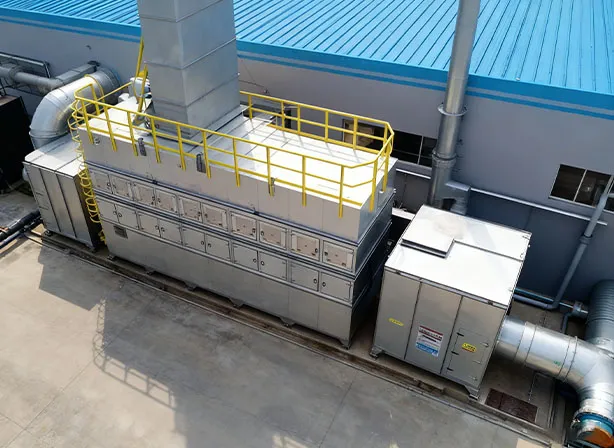
Many industrial exhaust gas streams contain more than VOCs. They may also contain paint mist, oil mist, dust, resin particles, fibers, or other particle matter. If these contaminants enter activated carbon directly, they can block the carbon channels and reduce purification performance.
Pre-filtration protects the carbon. It removes particle matter before the gas enters the adsorption chamber. This is especially important for spray booths, coating lines, grinding plus coating workshops, and processes where dust and VOCs appear together.
A common arrangement may include:
Exhaust Gas Source
↓
Mist / Particle Pre-Filter
↓
HAC Honeycomb Activated Carbon Module
↓
Fan Section
↓
Clean Gas Discharge
This is also where Senserui’s background in industrial dust collection becomes valuable. Many factories need both dust collection and VOCs control. When dust and VOCs are connected in the same production area, the system should be designed as one air pollution control plan.
Das HAC mainframe is especially useful when buyers need a compact, repeatable, and customizable exhaust gas treatment solution. It can support standard projects while still allowing customization. That balance is important for distributors, importers, engineering contractors, and plant owners.
For example, a contractor may need a solution for several spray booths with different airflow rates. A system integrator may need a modular unit that fits a limited machine room. A factory may need a system that can expand when production increases. HAC gives a practical starting point.
Typical project benefits include:
This modular approach helps Senserui provide a solution for our customers instead of forcing every customer into one fixed equipment size.
Senserui China is an industrial environmental equipment manufacturer specializing in industrial dust collection and VOCs treatment solutions. We serve medium- and large-scale manufacturers, environmental engineering contractors, system integrators, distributors, and importers across Europe, North America, the Middle East, Southeast Asia, and Latin America.
Our customers care about more than equipment price. They want stable operation, safety, energy efficiency, local emission compliance, modular design, customization, and remote support. They want a Chinese manufacturer with real engineering capability, not a one-time trader.
Senserui China can support:
For overseas customers, we focus on long-term cooperation. A good exhaust gas treatment project should run well after installation, not only look good in a quotation.
An HAC exhaust gas treatment mainframe is a modular industrial VOCs purification unit. It usually uses honeycomb activated carbon to adsorb VOCs and odor from exhaust gas produced by spray booths, coating lines, printing, chemical workshops, and other industrial processes.
In this product context, HAC refers to a honeycomb activated carbon-based exhaust gas treatment mainframe. The key treatment material is high-iodine honeycomb activated carbon, which adsorbs suitable VOCs from industrial exhaust gas.
No. HAC is mainly for industrial VOCs purification. A diesel exhaust gas aftertreatment system often uses SCR, diesel particulate filters, oxidation catalysts, or exhaust gas recirculation to control NOx and particulate emissions from diesel engines.