Für eine schnellere Antwort geben Sie bitte Ihre WhatsApp- oder Skype-Nummer in Ihre Nachricht ein, damit wir Sie so schnell wie möglich kontaktieren können.
Um uns eine schnellere Antwort zu ermöglichen, hinterlassen Sie bitte Ihre WhatsApp-Nummer, E-Mail oder Projektdetails. Wir antworten normalerweise innerhalb von 24 Stunden. Bei dringenden Anfragen kontaktieren Sie uns über WhatsApp: +8617862411260 oder WeChat: +8617862411260. Rufen Sie uns direkt an.
Industrial dust extractors fall into five configuration types: point-of-source workstation units, mobile extractors, compact fixed collectors serving one production cell, centralized mainframes connected by ducting, and centralized systems with integrated dust storage. The right type depends on how many pickup points you have, how often they run together, and the dust’s particle size and combustibility.
Most guides list extractors by filtration principle: baghouse, cartridge, cyclone, wet scrubber. That taxonomy matters, but it answers a later question. The first decision a plant makes is structural: does each machine get its own unit, or does one fan serve many pickup points through ducting?
Get that wrong and no filter choice will fix it. A cartridge collector that suits fine dust still performs badly if it is undersized for 20 simultaneous pickup points. A centralized system can also waste energy if most of its branches sit idle most of the shift.
The list below follows that structural decision. Filter media come up inside each type where they change the outcome.
1. Point-of-Source Workstation Units
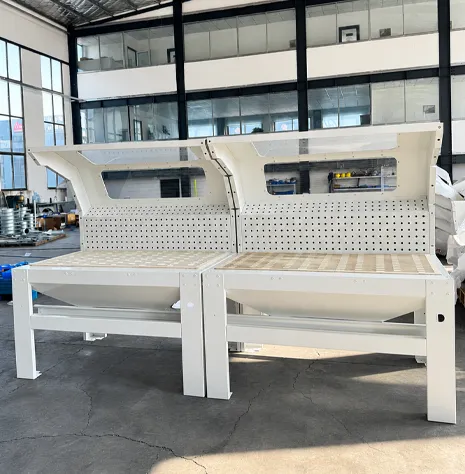
These units capture dust within a short distance of where it is generated. Examples include downdraft grinding tables, standalone collectors bolted beside a single grinder, and compact units serving one welding bay. Senserui’s PW Series Grinding Dust Collection Table and PD Series Standalone Grinding Dust Collector belong here. Both use replaceable filter elements and a fire-arresting or spark-interception structure.
Best for: isolated workstations, small workshops, and processes that run independently of the rest of the plant.
Real limitation: each unit has its own filter to change and its own dust drawer to empty. Ten tables means ten maintenance points spread across the shop floor. Once the station count grows, that labor often costs more than the hardware.
2. Mobile and Portable Extractors
Mobile extractors are wheeled or carried units that move between tasks. This category includes the vacuum-type extractors sold alongside power tools and the bag-type chip extractors common in small woodworking shops.
In the power-tool segment, mobile extractors are typically sold by dust class (L, M or H), which indicates the hazard level of dust the unit is rated to handle. That classification describes the extractor’s filtration and containment. It does not tell you whether the unit can serve production machinery.
Best for: maintenance crews, construction-style tasks, sanding with hand tools, and cleanup.
Real limitation: airflow is limited and the hose length adds resistance. These units are built to follow one tool, not to keep a production line clean. Plants that rely on them for fixed machines usually find that operators skip hookups for short jobs.
3. Compact Fixed Collectors for a Single Production Cell
This is the middle ground that many plants overlook. A compact collector sits outside or beside one production cell and serves a handful of machines through a short duct run. It is fixed, so connections stay in place, but it does not require plant-wide ducting.
Senserui’s S Series Dust Control Mainframe (3–15 kW, 3,000–15,000 m³/h) is designed for fine and ultrafine particulate in this role. It uses vibration-assisted ash cleaning and multi-sensor safety monitoring. Typical applications include pharmaceutical manufacturing, battery materials and electronics.
Best for: a single process area with fine dust, cleanroom-adjacent production, or a pilot line you expect to replicate.
Real limitation: each cell needs its own collector. If you later connect three cells, three compact units can cost more to run and service than one centralized system sized for the combined load.
4. Centralized Dust Collection Mainframes
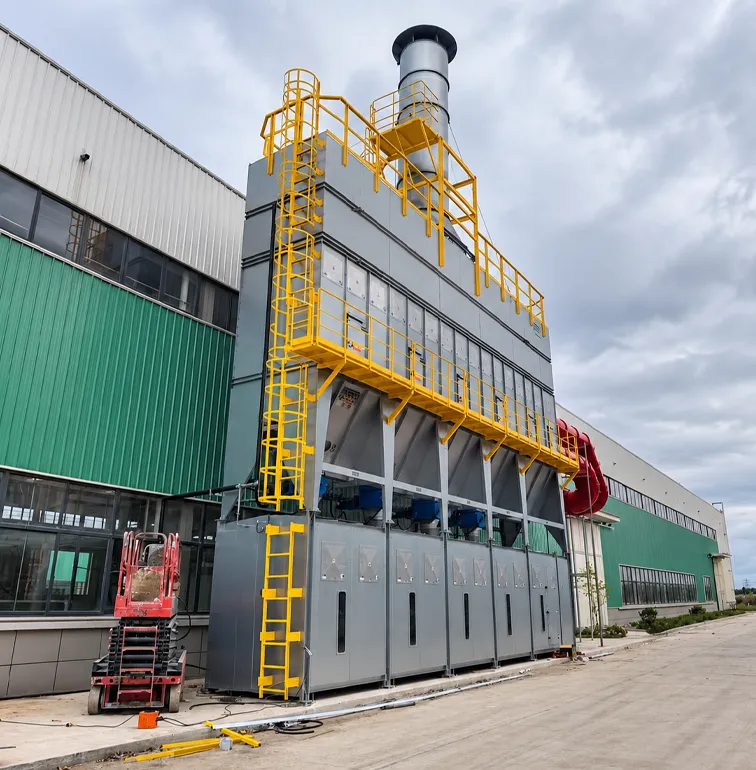
A centralized mainframe sits outside the production hall and connects to every pickup point through a duct network with branch valves. One fan system, one filtration stage and one discharge point serve the whole floor.
Within this type, the dust profile decides the series:
Compared with a shop full of mobile or point-of-source units, a centralized system moves noise, filter changes and dust handling out of the production area. Operators connect nothing. They open a valve.
Best for: plants with many fixed machines running at overlapping times.
Real limitation: the duct network is the system. Poor duct design (wrong diameters, too many elbows, branches added later without recalculation) loses suction at the far end of the line, and the mainframe cannot compensate. A centralized project also takes longer to plan and install than buying standalone units, and relocating machines later means changing ductwork.
5. Centralized Systems with Integrated Dust Storage
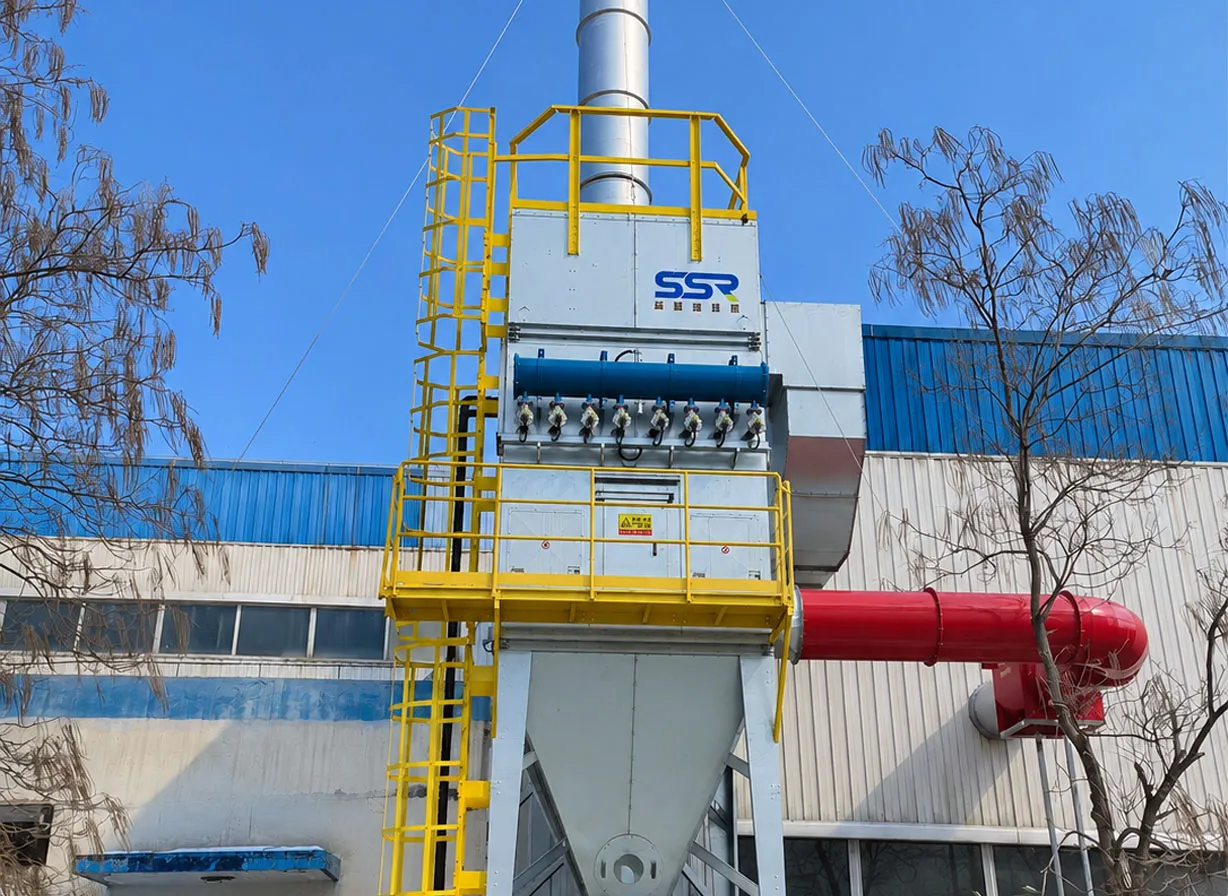
At high dust volumes, emptying bins becomes its own problem. This configuration pairs a centralized mainframe with a storage silo or dust bin, so collected material discharges into a container sized for days of production.
Senserui offers two storage formats:
Best for: high-throughput woodworking and furniture plants, and any site where collected dust is sold, burned or hauled in bulk.
Real limitation: a silo is a large structure. It needs foundations, site space and possibly planning approval. Stored combustible dust also concentrates fire and explosion risk in one place, so the storage must be part of the hazard analysis, not an afterthought.
| Factor | Point-of-source | Mobile | Compact cell-level | Centralized | Centralized + storage |
| Pickup points served | 1 | 1 (moves) | A few, in one area | Many, plant-wide | Many, plant-wide |
| Ducting required | None or minimal | Hose only | Short runs | Full network | Full network + discharge |
| Noise at the workstation | At the station | At the station | Moved outside the cell | Moved outside the hall | Moved outside the hall |
| Filter maintenance points | One per unit | One per unit | One per cell | One | One |
| Dust handling | Manual, per unit | Manual, per unit | Per cell | Central discharge | Bulk silo or bin |
| Expansion | Add units | Add units | Add cells | Add branches (requires recalculation) | Add branches; storage is fixed |
| Upfront planning | Low | Low | Moderate | High | Highest |
| Main risk if misapplied | Labor overhead at scale | Operators skip hookups | Duplicate units after growth | Weak suction at far branches | Storage becomes the hazard focus |
The table lists the four series named in this article’s scope. Figures come from Senserui’s published product data.
| Series | Configuration role | Rated power | Airflow | Approx. dimensions (L × W × H) | Dust profile | Published notes |
| W-Serie (W1.1 / W2.2 / W3) | Localized, single point | 1.1–3 kW | 700–2,000 m³/h | 700 × 350 × 1,360 mm | Welding, grinding, small metalworking | Compact footprint for individual stations |
| S-Serie (S3 / S5.5 / S7.5 / S11 / S15) | Compact cell-level | 3–15 kW | 3,000–15,000 m³/h | 2,000 × 1,200 × 3,200 mm to 2,100 × 2,100 × 6,000 mm | Fine and ultrafine | Vibration-assisted cleaning; multi-sensor monitoring |
| CC-Serie (CC30–CC150) | Centralized | 30–150 kW | 30.000–150.000 m³/h | 3,500–13,000 × 2,400 × 8,500 mm | Medium and large particles | Noise <80 dB; emission target <5 mg/m³ under suitable conditions |
| CP-Serie (CP30–CP150) | Centralized | 30–150 kW | 30.000–150.000 m³/h | 3,500–13,000 × 2,400 × ~7,000 mm | Fine and ultrafine | Noise <80 dB; emission target <5 mg/m³
|
One pattern worth noting: across the published ranges for the S, CC and CP series, nominal airflow runs at roughly 1,000 m³/h per kilowatt of rated power. That is a quick sanity check when you compare quotations, though actual fan selection depends on system pressure loss, not on this ratio.
The CC and CP series share power and airflow ranges. The choice between them follows particle size, not plant size.
Sizing for the total of all pickup points. Adding every machine’s airflow requirement assumes everything runs at once. If half the stations are idle at any time, a centralized system sized to the full sum wastes energy. Multi-fan designs that run only the fans needed for current demand address this, but the starting point is an honest simultaneity estimate.
Treating a power-tool dust class as a plant specification. An M-class or H-class mobile extractor handles hazardous dust at one tool. It says nothing about capacity for a production line.
Mixing incompatible dusts in one system. Sparks from metal grinding entering a duct that also carries wood dust create an ignition path. Separate systems, or spark detection and suppression designed for the specific mix, are needed.
Leaving storage out of the first plan. Plants add a silo after the collector is running, then discover the discharge height, footprint or safety isolation does not match. Storage volume belongs in the initial calculation.
Senserui does not publish fixed prices. Price is available on request based on system configuration and project requirements.
The reason is structural. In a centralized system, ducting, valves, installation, safety components and automation can account for as much of the project as the mainframe itself, and those depend on your floor plan. The cost drivers that move a quote most are total airflow, duct length and complexity, the filtration grade the dust requires, safety equipment for combustible dust, storage volume, and whether IoT monitoring is included.
For a fair comparison between configurations, compare running costs too: energy at realistic utilization, filter replacement frequency and the labor of emptying multiple dust containers.
If your dust is combustible (wood, many metals, food powders, battery materials and some plastics fall into this group), the configuration decision is also a safety decision.
NFPA 660, Standard for Combustible Dusts and Particulate Solids (2025 Edition), published by the National Fire Protection Association, consolidates the NFPA requirements for combustible-dust fire and explosion hazards, including dust collectors and dust hazard analysis. In the United States, OSHA provides combustible-dust guidance that may apply under general-industry regulations. In the EU, Directive 2014/34/EU (ATEX) covers equipment and protective systems for potentially explosive atmospheres.
Practically, this affects the configuration choice in two ways. Centralized systems concentrate dust, so explosion relief, isolation and spark detection must be designed into the mainframe and the storage. Many small units spread across a hall distribute the hazard but multiply the number of points that need inspection.
Senserui states that its explosion-protection design is based on ATEX principles. The company does not publish an ATEX certificate number, so buyers who require certified equipment should request documentation for the specific configuration.
Q: What is the difference between a dust extractor and a dust collector?
A: In practice the terms overlap. “Dust extractor” is common for mobile and tool-connected units, while “dust collector” is more common for fixed industrial systems. Both capture and filter airborne particulate; configuration and capacity matter more than the name.
Q: How many workstations justify a centralized system?
A: There is no fixed threshold. The deciding factors are how many points run at the same time, how far apart they are, and the labor cost of maintaining separate units. An airflow and duct calculation based on your layout gives a defensible answer.
Q: Can one centralized system handle both wood and metal dust?
A: It is generally inadvisable without specific engineering. Sparks from metal processes can ignite combustible wood dust in shared ducting or filters. Separate systems are the usual approach.
Q: Does Senserui publish prices for the W, S, CC and CP series?
A: No. Pricing is available on request because it depends on airflow, ducting, filtration, safety components and plant layout.
Q: Are Senserui dust collectors ATEX certified?
A: Senserui states that its explosion-protection design is based on ATEX principles. No ATEX certificate number is publicly listed, so request documentation if your project requires certified equipment.