Per una risposta più rapida, ti preghiamo di includere il tuo WhatsApp o Skype nel tuo messaggio in modo che possiamo contattarti il prima possibile.
Per aiutarci a rispondere più velocemente, ti preghiamo di lasciare il tuo WhatsApp, email o dettagli del progetto. Di solito rispondiamo entro 24 ore. Per richieste urgenti, contattaci su WhatsApp: +8617862411260 o WeChat: +8617862411260. chiamaci direttamente.
Una dust extraction system in the pharmaceutical industry must do more than move air: it has to contain potent powders at the source, stop one product’s dust from reaching another, survive repeated cleaning, and manage combustible-dust risk. Those four requirements, not airflow alone, should drive equipment selection and duct design.
In woodworking or metal fabrication, a dust collector is judged mostly on capture velocity, filtration efficiency and how much housekeeping it saves. Those measures still apply in a pharmaceutical plant. They are just the starting point.
Four constraints change the design:
A system that handles the first three but ignores the fourth is unsafe. One that handles explosion risk but leaks between suites is non-compliant.
Airflow numbers come last. The powder data comes first, because it decides the capture method, the filter arrangement and the explosion-protection concept.
| Powder property | Who usually provides it | What it changes in the extraction design |
| Occupational exposure band / limit | Toxicology or occupational health team | Whether open hoods are acceptable or isolators, safe-change filters and sealed discharge are needed |
| Combustibility data (explosion severity, minimum ignition energy) | Accredited dust testing lab | Venting, suppression or isolation choice; equipment zoning; grounding requirements |
| Particle size distribution | Process development / QC | Filter media selection; transport velocity needed to keep dust from settling in ducts |
| Hygroscopic or sticky behaviour | Process development | Risk of filter blinding; duct slope and access-door spacing; cleaning frequency |
| Number of products sharing the area | Production planning | Dedicated versus shared extraction; changeover cleaning scope |
If combustibility data does not exist, do not assume the powder is safe. NFPA 660 (Standard for Combustible Dusts and Particulate Solids, 2025 Edition) consolidates NFPA’s requirements for combustible-dust hazards, including dust hazard analysis. OSHA’s combustible dust resources cover the U.S. general-industry hazards that apply to dust collectors and powder handling.
General room exhaust dilutes dust after it has already reached the operator’s breathing zone. Pharmaceutical extraction should capture as close to the emission point as the process allows. Typical points include dispensing booths, sieving and milling stations, granulator charging, tablet press and capsule filler exhaust, coating pan exhaust and drum or IBC charging.
Two details are easy to miss:
Weighing stations are an edge case. Strong capture velocity near an analytical balance makes readings drift. Dispensing hoods and downflow booths are designed to balance capture against weighing stability, so their extraction volume should come from the booth supplier’s specification rather than a generic hood formula.
Extraction changes room pressure. Pharmaceutical suites usually run a pressure cascade between rooms and corridors. Every cubic meter the extraction system removes has to be replaced by the HVAC system. When an extraction branch opens or closes, room pressure shifts. The extraction controls and the HVAC controls need to be designed together, with branch valve states included in the pressure-balance calculation.

The first decision is architectural: dedicated extraction per suite or line, or one shared system with isolation.
Dedicated units remove the shared duct path entirely. They cost more in equipment count and floor or technical-area space, but changeover cleaning is contained to one line, and a fault in one unit affects one suite.
A shared system can be acceptable for low-hazard products, provided the duct network is designed against backflow and settling:
For highly potent compounds, dedicated extraction is the usual starting point, and a shared system needs a documented justification.
Compared with the large centralized systems commonly used in woodworking or metal fabrication, pharmaceutical extraction trades scale for control.
| Design dimension | Typical general industrial system | Pharmaceutical extraction system |
| Primary objective | Dust removal, housekeeping, emission compliance | Operator exposure control, cross-contamination prevention, product quality |
| System scale | One central collector serving many points | Smaller units per suite or line, or a shared system with branch isolation |
| Capture method | Open hoods and machine connections | Isolators, booths and enclosed hoods for potent materials |
| Duct design driver | Pressure drop and energy | Backflow prevention, no settling, cleanability |
| Filter change | Routine maintenance task | Planned high-exposure event; safe-change method often required |
| Dust discharge | Open bin, drum or silo | Closed discharge into sealed container or liner |
| Surface finish | Painted carbon steel common | Material and finish chosen for the cleaning regime in process areas |
| Documentation | Manuals, wiring diagrams | Drawings, material certificates, test records, qualification support |
Cleaning validation fails on geometry more often than on chemistry. Before approving a collector or duct layout, look at it the way a cleaning operator will:
Discharge deserves its own review. A drawer or open bin that an operator empties by hand undoes the containment provided upstream. A closed discharge into a sealed liner or container keeps the collected powder enclosed until disposal.
A common assumption is that a high-efficiency filter makes the system contained. During normal operation it does. When a loaded cartridge is pulled out of its housing, the operator is standing next to the most concentrated dust in the plant.
Practical controls include:
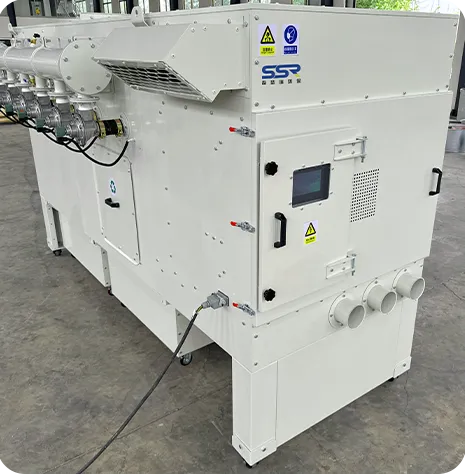
The Senserui S Series Dust Control Mainframe is a compact unit designed for fine and ultrafine particulate. Pharmaceutical manufacturing is listed among its target applications, alongside battery materials and electronics.
Where it fits: the airflow range suits a single suite, line or group of related emission points. That makes it a candidate for the dedicated-unit approach described above, where each line gets its own collector rather than sharing a central system. Its fine-dust orientation and sensor monitoring match the needs of powder-handling areas.
Where to be careful: the published S Series data does not state the material grade or surface finish of internal parts, whether a safe-change filter housing is available, the dust discharge method, or what qualification documentation is supplied. For a GMP project, request these in writing before shortlisting. The 15,000 m³/h upper limit also means larger multi-line facilities will need several units, or a larger series such as the CP Series (30,000–150,000 m³/h, designed for fine dust) for non-potent applications where a shared system is acceptable. At up to 6,000 mm tall, outdoor or technical-area placement for explosion venting needs to be planned in the site layout.
Senserui performs in-house airflow, noise and filter testing and factory inspection before delivery. Ask how those test records can support your factory acceptance testing.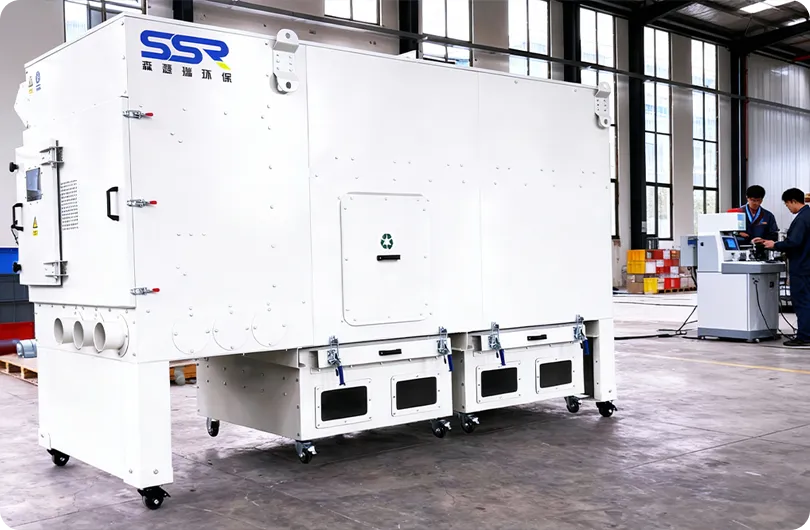 Specification Checklist: 7 Steps Before You Request Quotes
FAQ Can a general industrial dust collector be used in a pharmaceutical plant?For low-hazard, non-product-contact applications it sometimes can, but it usually needs changes: branch isolation, closed discharge, cleanable internals, and an explosion-protection concept matched to the powder. For potent APIs, containment requirements generally rule out standard open-discharge designs.Should each pharmaceutical suite have its own dust collector?Dedicated units remove the shared duct path that causes cross-contamination, so they are the usual choice for potent compounds or frequent product changeovers. Shared systems can work for low-hazard products if backflow prevention and duct velocities are designed and documented. Are pharmaceutical powders a combustible dust risk?Many are, because a large share of excipients and APIs are organic. Only testing confirms it for a specific powder. NFPA 660 and the EU ATEX framework (Directive 2014/34/EU) are the main references for assessing and controlling the hazard.How often should filters be changed?There is no fixed interval. Use differential-pressure monitoring to track filter loading, and schedule changes between batches using a written procedure suited to the powder’s exposure band. What airflow does the Senserui S Series cover?The S Series spans 3,000–15,000 m³/h across models S3 to S15, with rated power of 3–15 kW. Configuration for a specific line depends on the number of capture points and their required airflow.
| Parameter | S Series published data |
| Models | S3 / S5.5 / S7.5 / S11 / S15 |
| Rated power | 3–15 kW |
| Airflow | 3,000–15,000 m³/h |
| Representative dimensions | approx. 2,000 × 1,200 × 3,200 mm to 2,100 × 2,100 × 6,000 mm |
| Filter cleaning | Vibration-assisted ash cleaning |
| Safety | Multi-sensor safety monitoring |
| Company-level quality and compliance | ISO 9001:2015 quality management; CE compliance; explosion-protection design based on ATEX principles |
| Price | Available on request based on system configuration and project requirements |