Per una risposta più rapida, ti preghiamo di includere il tuo WhatsApp o Skype nel tuo messaggio in modo che possiamo contattarti il prima possibile.
Per aiutarci a rispondere più velocemente, ti preghiamo di lasciare il tuo WhatsApp, email o dettagli del progetto. Di solito rispondiamo entro 24 ore. Per richieste urgenti, contattaci su WhatsApp: +8617862411260 o WeChat: +8617862411260. chiamaci direttamente.
A silica dust extraction system captures respirable crystalline silica at the point where it is generated, moves it through ducting, and traps it in a filtered collector.
Respirable crystalline silica is not “fine dust” in general. Under OSHA’s definition, it means quartz, cristobalite, and/or tridymite carried in airborne particles that a respirable-size sampler meeting ISO 7708:1995 would collect. These particles are small enough to reach the gas-exchange region of the lung, and that is why a system built for them has to be specified differently from a system for coarse chips.
A working system has five parts, and each one can fail on its own:
Most performance problems we see in silica applications start at part 1 or part 5. They rarely start at the filter.
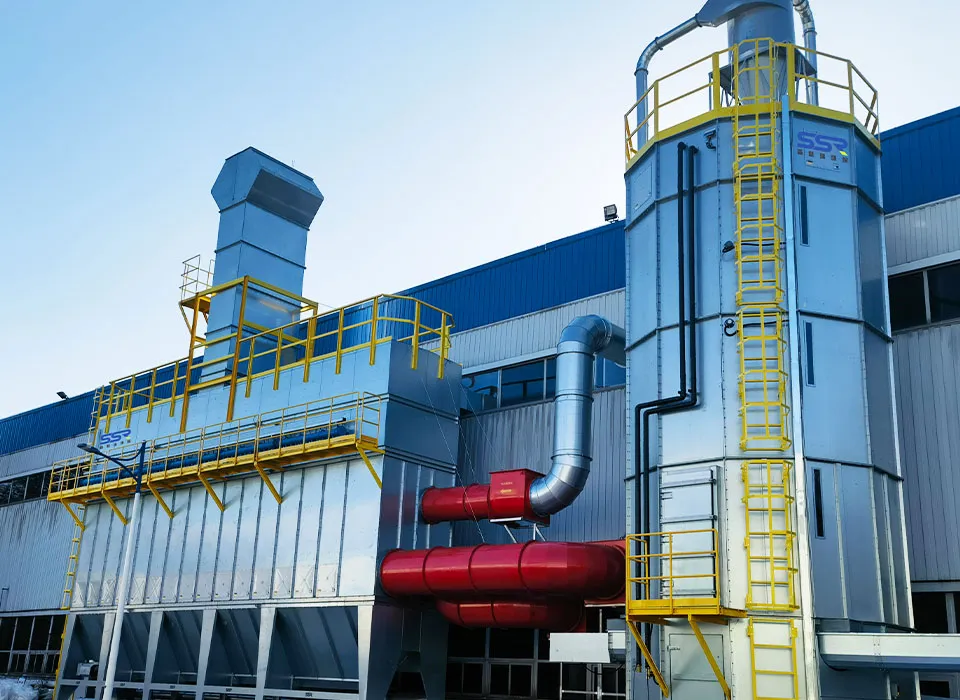
OSHA puts engineering controls ahead of respirators. Under the general industry standard, employers must use engineering and work practice controls to bring exposure down to or below the PEL, unless they can show those controls are not feasible. Extraction is one of several engineering options, and it works best alongside the others.
| Control level | Example in silica-generating work | What extraction contributes |
| Elimination / substitution | Lower-silica abrasives or raw materials | Nothing directly. This step reduces the load the extraction system has to handle |
| Engineering: enclosure | Enclosed crushing, sealed mixing hoppers | Enclosure keeps dust contained, and extraction keeps the enclosure under negative pressure |
| Engineering: wet methods | Water-fed saws and cutters | Often used instead of dry extraction at the tool; mixing wet slurry into a dry collector creates caking problems |
| Engineering: local exhaust ventilation | Hoods on grinders, polishers, bag-dump stations | This is the core role of a dust extraction system |
| Work practices / administrative | Vacuum cleaning instead of dry sweeping, rotation, regulated areas | Central vacuum drops on the same system support housekeeping |
| Respiratory protection | Respirators where exposure still exceeds the PEL | None. Respirators cover the gap that remains |
For construction work, the controls are task-based. Construction exposures fall under 29 CFR 1926.1153 rather than the general industry standard, and that standard lists specified controls for common tasks.
A filter can only clean the air that reaches it. The following gaps sit outside the collector:
1.Characterize the material. Collect safety data sheets and any objective data on silica content for each material processed. Done when every dust-producing material has a documented silica content or a note that it is unknown.
2.Measure baseline exposure. Run personal breathing-zone sampling on the highest-exposure workers before the design is fixed. Done when you have 8-hour TWA results by task.
3.Design capture point by point. For each source, define the hood type, its distance to the source, and the required airflow. Done when every source has a written airflow figure, not a single plant-wide number.
4.Size ducting for transport velocity. Add the source airflows plus allowance for simultaneous use, then size branches so velocity stays high enough for fine mineral dust across the farthest run.
5.Select filtration for the respirable fraction. Ask suppliers for filter efficiency data at fine particle sizes, not just a general emission figure. If they cannot provide it, record that gap.
6.Close the discharge path. Specify a sealed bin, silo, or bagging arrangement and a written filter-change procedure.
7.Re-measure after commissioning. Repeat breathing-zone sampling under normal production. Done when results are compared against the baseline from Step 2.
Crystalline silica itself does not burn, so explosion protection is often left off silica-only systems. That reasoning breaks down when the same duct network also serves wood, polymer, resin-bonded, or metal dust processes. A mixed stream needs a combustibility assessment. NFPA 660 (2025 Edition), the National Fire Protection Association’s consolidated standard on combustible dusts and particulate solids, is the reference for that evaluation and for dust hazard analysis. Do not assume a mixed stream is non-combustible because silica is the dust of concern.
The two lines below are the ones most often considered for fine mineral dust. All figures are from Senserui’s published product data.
| Parameter | CP Series (CP30–CP150) | S Series (S3–S15) |
| Configuration | Centralized dust control mainframe | Compact dust control mainframe |
| Rated power | 30–150 kW | 3–15 kW |
| Airflow | 30.000–150.000 m³/h | 3,000–15,000 m³/h |
| Approximate dimensions | L 3,500–13,000 × W 2,400 × H 7,000 mm | From about 2,000 × 1,200 × 3,200 mm to 2,100 × 2,100 × 6,000 mm |
| Operating noise | <80 dB | Not published |
| Particulate emission target (outlet) | <5 mg/m³ under suitable system conditions | Not published |
| Notable features | Designed for fine and ultrafine dust | Vibration-assisted ash cleaning; multi-sensor safety monitoring |
| Published typical uses | Sanding, fine grinding, polishing, CNC processing, powders, battery materials | Pharmaceutical, battery materials, electronics, fine-dust applications |
| Price | Available on request based on system configuration and project requirements | Available on request based on system configuration and project requirements |
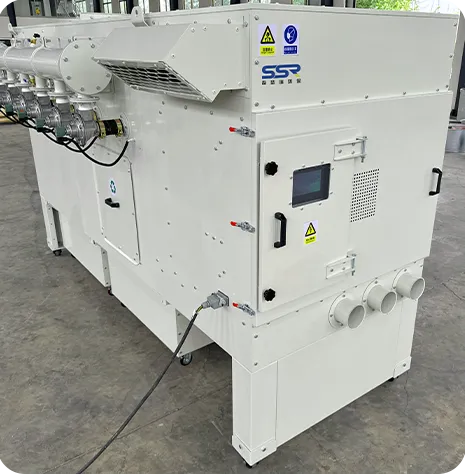
Senserui’s Serie CP supports centralized fine-dust control with higher airflow and power, while the compact Serie S suits smaller installations. Selection depends on dust characteristics, required airflow, available space, and project requirements.

Bring four items: the process list with dust-producing steps, safety data sheets or silica content data for each material, any existing breathing-zone monitoring results, and a plant layout drawing with distances from each source to a possible collector location.
No. A collector is an engineering control. Compliance depends on measured employee exposure staying at or below the 50 μg/m³ PEL (8-hour TWA), plus exposure assessment, work practices, and other requirements in 29 CFR 1910.1053 or 1926.1153.
It is possible only with additional high-efficiency filtration and monitoring designed for that purpose. A standard outlet emission target such as <5 mg/m³ is meant for discharge to atmosphere, not for indoor recirculation.
Crystalline silica does not burn. Risk appears when the same system also handles combustible dust such as wood, polymers, or metals. In that case, assess the mixed stream using NFPA 660.
Centralized systems suit stable layouts with many sources and remove filter changes from the work area. Compact systems suit individual lines, smaller airflow needs, or plants whose layout changes often.
Senserui does not publish fixed prices. Price is available on request based on airflow, number of sources, duct layout, filtration, dust discharge, and safety configuration.