Für eine schnellere Antwort geben Sie bitte Ihre WhatsApp- oder Skype-Nummer in Ihre Nachricht ein, damit wir Sie so schnell wie möglich kontaktieren können.
Um uns eine schnellere Antwort zu ermöglichen, hinterlassen Sie bitte Ihre WhatsApp-Nummer, E-Mail oder Projektdetails. Wir antworten normalerweise innerhalb von 24 Stunden. Bei dringenden Anfragen kontaktieren Sie uns über WhatsApp: +8617862411260 oder WeChat: +8617862411260. Rufen Sie uns direkt an.
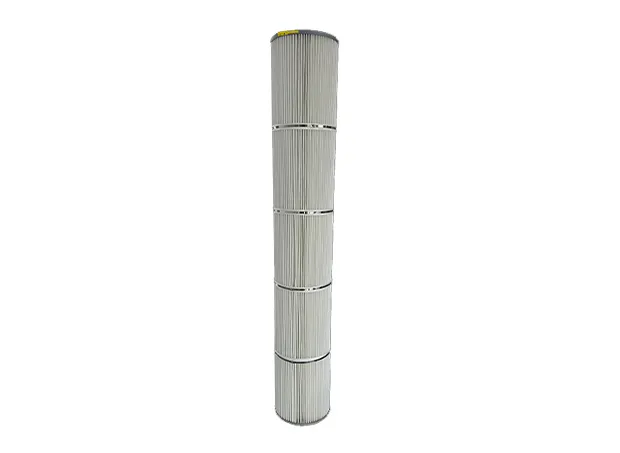
A pleated Filterpatrone packs a large filtering area into a small cylinder by folding the media into pleats. In a pulse-jet dust collector, that means a smaller housing for the same airflow than bags, and lower pressure drop when pleat count and spacing are chosen well. The trade-off is that pleats that are too tight or too deep hold dust, which makes cleaning harder. This guide explains the three specs that matter, then compares cartridges with bag filters for woodworking and furniture plants.
A pleated cartridge is a cylindrical filter element: pleated media wrapped around a perforated core, closed by end caps with a gasket. In a pulse-jet collector, dusty air flows from the outside of the cartridge to the inside, dust builds a cake on the outer surface, and a burst of compressed air from the inside knocks the cake into the hopper.
Media area
Media area is the total filtering surface, usually in square feet or square metres. For a given airflow, more media area means a lower air-to-media ratio, which means slower air through the media, less dust driven into the fibres and a lower, steadier pressure drop. When comparing quotes, ask for the area per cartridge and the total area per collector, not just the number of cartridges.
Pleat count
Pleat count is the number of folds around the cartridge. More pleats give more area in the same diameter, but only up to a point. Past that point, the folds crowd together and the extra area cannot be used.
Pleat spacing and depth
Pleat spacing is the gap between neighbouring folds. If the gap is too narrow, fine and fibrous wood dust bridges across it, the pulse cannot clear it, and the usable area shrinks. Deep pleats add area but are harder to clean from the bottom of the fold. Wood fibres, sander dust and sticky MDF fines all favour a more open pleat pack than fine, free-flowing dust does.
| Spec | More of it helps | Too much hurts |
| Media area | Lower air-to-media ratio, longer life | Larger, costlier element |
| Pleat count | More area per cartridge | Folds crowd and trap dust |
| Pleat spacing | Open folds release the cake | Wide spacing reduces area |
| Pleat depth | More area in the same diameter | Bottom of the fold cleans poorly |
Pressure drop across a cartridge comes from the clean media plus the dust cake on it. Extra media area lowers it by spreading the load. Open pleat spacing keeps the cake loose enough for a pulse to remove it, so pressure drop recovers after each cycle. A cartridge with high nominal area but packed pleats can therefore perform worse in service than one with less area and better spacing. Ask a supplier for the effective area and the pleat spacing, not only the headline area.
| Faktor | Pleated cartridge | Bag filter |
| Footprint for the same airflow | Smaller, more media per unit volume | Larger housing |
| Changing elements | Quick, often from the clean side | More labour, taller access |
| Fibrous, sticky dust | Can bridge in tight pleats | Smooth surface releases fibres easily |
| Heavy dust loading | Needs open pleats and good pre-separation | Tolerates heavy loads well |
| Cost per unit of media area | Often higher up front | Often lower |
A reasonable rule: cartridges suit plants with limited floor space and moderate loads, such as sanding and finishing lines. Bags can suit very heavy, fibrous loads, such as primary machining and large-volume mills. Many furniture plants mix both. Confirm which fits your dust with a short airflow and dust-load review.
For each cartridge, ask for:
Is a pleated cartridge better than a bag filter?
Not always. Cartridges save space and make changeouts faster; bags handle heavy or very fibrous loads more easily. The right choice depends on dust type, loading and floor space.
Does a higher pleat count always mean better filtration?
No. Past a certain count the folds crowd, dust bridges between them and the usable area drops.
What is a good air-to-media ratio?
It depends on the dust and the media; manufacturers publish recommended ranges. A lower ratio is gentler on the filter. Use the supplier’s figure for your dust rather than a generic number.
Why does my cartridge still show high pressure drop after pulsing?
Common causes are tight pleat spacing, damp or sticky dust, weak pulse pressure or a cartridge near the end of its life.
Can I use the same cartridge for MDF and solid-wood dust?
Often not ideal. MDF fines are finer and stickier, so check with the supplier about media and pleat spacing for each dust.